
Insurance distribution is under pressure from multiple directions at once. Customer expectations have shifted toward digital-first, on-demand experiences. Agent demographics are changing. And AI is beginning to reshape what distribution work actually requires of humans. In fact, a recent BofA Global Research report estimates that more than $15 billion in insurance commissions are tied to “low-complexity” transactions that face a real risk of AI disintermediation.
For P&C carriers, the response isn’t simply adding channels or upgrading portals. It requires rethinking how distribution is structured — from how insurers acquire and engage customers and how they equip and support agents to how their products reach buyers across an expanding range of touchpoints.
The Forces Reshaping Insurance Distribution
From how policies are sold to how agents are supported, distribution modernization is touching every part of the value chain. Here are five areas where leading carriers are shifting their focus.
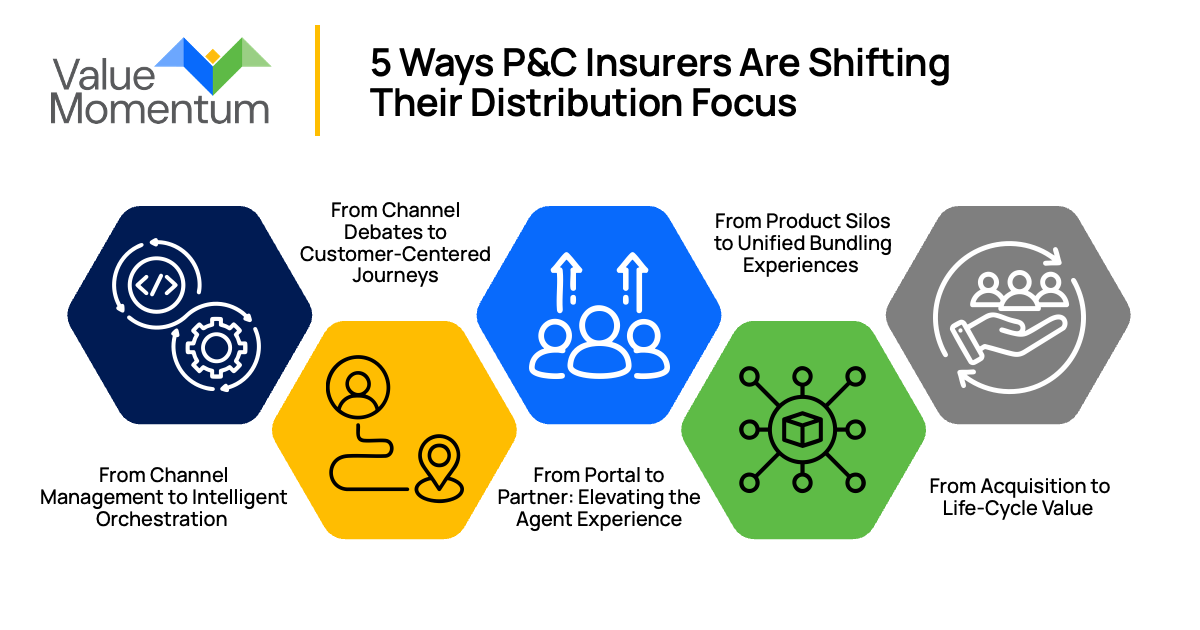
- From Channel Management to Intelligent Orchestration
For years, insurance distribution operated on a straightforward premise: manage the right mix of channels and the business would follow. That model is giving way to something more dynamic. Modern customers expect speed and relevance at every touchpoint, and carriers are responding by moving toward intelligent orchestration. In other words, they are using AI and data to make real-time decisions about how, when, and where to engage prospects and customers.
In practice, this means capabilities like lead scoring, dynamic offer personalization, and next-best-product recommendations that reduce acquisition costs and help agents prioritize high-value opportunities. It also means smarter channel routing and an expanding distribution footprint, meeting customers through embedded and ecosystem partnerships at the moment of need. Munich Re’s Next Insurance, for example, already offers an AI chatbot through which customers can purchase and bind commercial policies directly, without a human agent involved.
Data is what makes all this possible. Carriers that have invested in advanced analytics can optimize acquisition funnels, segment agents more effectively, and identify their most profitable customer segments. And that data picture grows richer as API integrations with partners and intermediaries become rich and domain-specific. UFG Insurance demonstrated this when it built an online quoting experience for businessowners’ policies, reducing quoting questions and improving risk selection in the process.
2. From Channel Debates to Customer-Centered Journeys
The debate over whether direct-to-consumer or agent-led distribution is the winning model may be missing the point. Customers don’t think in channels; they think in convenience. They want the ability to start a quote online, move through straightforward steps digitally, and access a knowledgeable agent when a decision gets complex.
The carriers gaining ground are those building journeys that accommodate both, rather than forcing a choice between them. This “digital-first, human-available” model requires seamless quoteflow requiring multiple touchpoints to work together, preserving quote context across channels, enabling seamless handoffs between direct and agent interactions, and equipping agents with the AI-driven insights they need to pick up mid-journey without friction.
The goal is a distribution experience that maximizes conversion while protecting the agent relationships that remain essential for complex or high-value policies.
3. From Portal to Partner: Elevating the Agent Experience
Carriers have historically invested heavily in the customer-facing side of distribution while underinvesting in the tools and experiences they provide to agents. The gap is becoming harder to ignore. According to the J.D. Power 2025 U.S. Independent Agent Satisfaction Study, just 56% of personal lines agents and 57% of commercial lines agents say their carriers are meeting their foundational needs. 25% of personal lines agents say they don’t feel valued as partners at all. Agents increasingly factor in the quality of carrier technology when deciding where to place business, and that dynamic is only intensifying.
The most visible area of investment is AI-powered agent tools that augment rather than replace agents, surfacing real-time underwriting guidance, risk-appetite alerts, and next-best-product recommendations during the quoting process. Insurers using agentic AI approaches can free up human experts to focus on high-value activities across the entire policy life cycle to increase customer lifetime value. The impact is tangible: faster quote turnaround, fewer back-and-forth underwriting exchanges, and higher close rates. The strategic ambition is equally significant, shifting the agent’s role from transaction facilitator to trusted advisor powered by intelligence.
But agentic copilots are only part of the picture. Agents expect their portals to function as a complete operational environment where they can quote and bind, manage their book of business, track commissions and incentive compensation in real time, and handle service requests without having to go offline with carrier operations. In other words, they want to be able to serve customers across the entire life cycle in a unified interface. Carriers that deliver on this reduce their own operational burden while building the kind of agent loyalty that translates directly into channel performance.
4. From Product Silos to Unified Bundling Experiences
Insurance products have traditionally been built, priced, and sold in silos, organized around internal system boundaries rather than the way customers actually think about their coverage needs. As digital distribution matures and customer expectations rise, that disconnect is becoming harder to accommodate. Rather than realizing midway through a buying cycle that a policyholder would benefit from bundling, insurers should help agents capture bundling intent up front. Not only does this improve customer satisfaction, but it can also improve an insurer’s chance of closure. For instance, an agent could help a small business owner looking for a businessowners policy bundle commercial lines products that address their full scope of risk to provide a more coherent journey.
Closing that gap requires carriers to invest in the enterprise architecture and API infrastructure needed so support unified quoting experiences spanning multiple policy admin systems, with dynamic bundling logic embedded directly in the customer journey. The goal is to abstract internal system complexity away from the experience entirely so that what happens on the back end never creates friction on the front end. For carriers still operating in product silos, this is not only a meaningful modernization challenge, but also a significant competitive opportunity.
5. From Acquisition to Life-Cycle Value
For most of its history, insurance distribution has been measured primarily by new business, such as policies written, premiums bound, and customers acquired. That lens is shifting. As acquisition costs rise and customer expectations for ongoing engagement increase, carriers are recognizing that distribution doesn’t end at the point of sale. The real opportunity lies in what happens after.
Modern distribution strategies are increasingly built around the full customer life cycle — using data and digital touchpoints to drive renewals, surface cross-sell opportunities, and keep policyholders engaged between transactions. Behavioral nudging for renewals, personalized outreach based on life events, and expanded digital self-service capabilities are all part of this shift.
Carriers that invest in these capabilities develop a richer, more accurate picture of their customers over time, improving segmentation, informing pricing, and making it easier to identify and act on retention risk early.
These trends point to the same underlying shift: Distribution is becoming less about managing channels and more about using agentic orchestration to deliver intelligent, connected experiences across the entire customer and distribution life cycle.
Building the Distribution Organization of the Future
The carriers leading the next phase of distribution think of it as a connected system rather than a collection of channel initiatives. Agentic orchestration, seamless customer journeys, empowered producers, unified product access, and life-cycle engagement compound each other. Investing in one without the others yields diminishing returns.
As distribution models continue to evolve, the window to act with intention is narrowing. Carriers that sequence modernization around both agent and customer experience will be better positioned to grow profitably and build lasting channel loyalty.
To learn more about how P&C carriers are modernizing the agent experience and driving profitable growth through distribution, watch our on-demand webinar, “Ask the Experts: Modern Agent Portals: Elevating Experience and Driving Profitable Growth.”