

Despite the net loss ratio for personal auto improving from 75.2% in 2023 to 65.8% in 2024, the total amount of claims dollars spent keeps increasing. And in commercial auto, the loss ratio continues to hover near 70% while this segment has garnered net underwriting losses topping $10 billion in the last two years.
Claims are taking longer to close, and costs like litigation, car rentals, and medical expenses continue to climb, creating a nightmare for both insurers and their policyholders. Insurers are left with loss ratios that are insufficient to offset costs and erode their underwriting profits, while customers are stuck dealing with claims cycles that seem to last ages.
Investing in better usage of telematics and pairing it with a strategic approach to artificial intelligence (AI) might prove to be the key for both personal and commercial auto insurers to reshape their claims workflows and improve the experience for employees and policyholders alike.
How AI and Telematics Help Insurance Claims
While telematics has primarily been used in personal auto, adoption is rising across additional lines like commercial auto fleet, and the global telematics market for automotive use is expected to surpass $170B by 2030. For insurers, this signals more than growth: It’s a chance to reimagine claims with real-time data for speed, fairness, and transparency.
Telematics, powered by connected vehicles, smart devices, and sensors, enables insurers to access real-time data from cars, mobile apps, dongles, dashcams, and more. While the use of telematics in personal auto lines is nothing new, moving past usage-based insurance and personal lines rewards programs can help insurers derive new value.
Applying the latest AI capabilities to the data collected from original equipment manufacturer (OEM) telematics and Internet of Things (IoT) devices helps make sense of that data at scale. This combination unlocks:
- Instant crash detection and automated first notice of loss (FNOL) through real-time sensor data
- Driver behavior insights enhanced by AI pattern recognition for more accurate risk profiling
- Faster, more accurate settlements supported by AI-driven damage assessment and predictive analytics
- Fraud prevention via anomaly detection and predictive scoring models
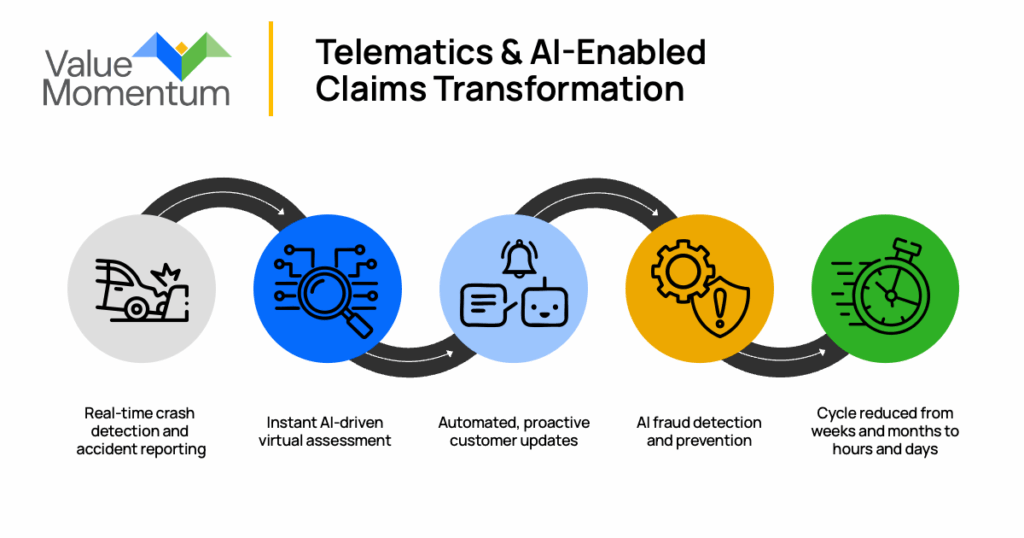
In short, telematics collects the data, then AI interprets the information and acts on it, helping turn claims from a slow, manually intensive process into a proactive, transparent, and personalized workflow.
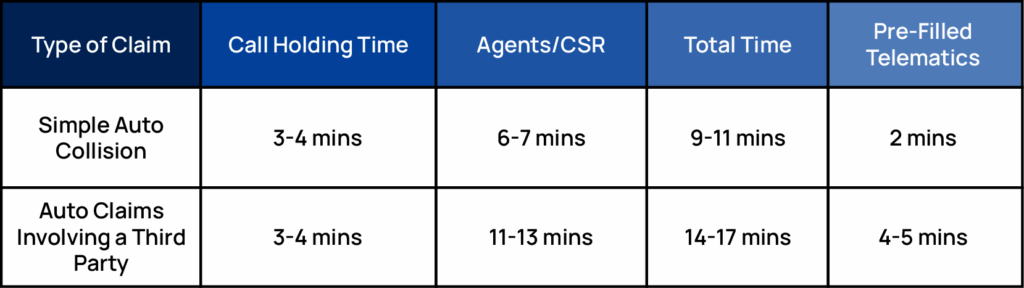
In our team’s analysis of client outcomes and industry data, we saw significant time savings for FNOL for a typical auto claim when applying telematics and AI to the process. In our team’s analysis of client outcomes and industry data, we saw significant time savings for FNOL for a typical auto claim when applying telematics and AI to the process. The table below shows the difference between phone-initiated claims for simple auto collisions and third-party auto collisions with manual processes versus with pre-filled telematics data. For both types of auto claim, there was almost 80% reduction in the time it took to submit FNOL.
Powering the Claims Workflow With AI and Telematics
Whether it is collected through original equipment manufacturer (OEM) sensors or via aftermarket apps, when integrated effectively into the workflow, telematics data flows seamlessly into an insurer’s claim system.
Keeping customers updated with real-time updates and automatically routing complex cases to specialized adjusters ensures a frictionless, intelligent process that brings quicker resolutions, fewer disputes, and greater trust from customers.
Here are five steps to prepare the technology foundation claims organizations need to drive a telematics and AI-driven process.
- Build a connected data ecosystem.
Integrating telematics with AI begins with access to quality, real-time data. Insurers should focus on building a connected data foundation that ensures seamless data flow from multiple sources. This requires establishing secure data connections with OEM platforms, aftermarket telematics providers, and mobile apps and creating a robust data ingestion layer capable of handling streaming data from sensors, dashcams, and IoT devices in real time.
Data should be consolidated in a centralized, cloud-based data lake, ensuring it is structured, standardized, and accessible for AI-driven analysis. When it comes to customer data, privacy is paramount. Implement strong data privacy and security measures to safeguard customer information and maintain regulatory compliance.
- Enable AI-driven insights and decisioning.
Once the data flows in, the next step is to apply AI models that can analyze it for value creation. Insurers will need to integrate a variety of AI technology into their workflows to ensure they are maximizing the value of the data held in their systems.
Computer vision models, for instance, can assess damage from crash images or dashcam footage into their processes. Additionally, predictive capabilities like machine learning algorithms can be used to predict injury severity, repair cost, or fraud likelihood. Natural language processing (NLP) is a critical capability to help claims teams interpret adjuster or customer notes for context.
- Leverage real-time data for proactive claims handling.
Real-time telematics data empowers insurers to transition from reactive claim management to a proactive and predictive approach. With a connected data ecosystem in place and AI-driven decisioning enabled, telematics devices can help insurers detect crashes instantly using telematics signals and trigger automated FNOL.
Once FNOL is automatically submitted, insurers can use event-based AI workflows to start policy verification, repair scheduling, and notifications. Throughout the process, the insurer can send real-time updates to customers through apps, SMS, or portals. When it comes to assigning adjusters, this data can be analyzed to predict loss trends and optimize adjuster assignments.
- Redesign claims workflows for human-in-the-loop AI collaboration.
Technology alone won’t drive transformation, but pairing it with workflow redesign will. Insurers should reimagine their claims processes to seamlessly integrate human expertise with AI automation.
For example, simple, low-severity claims can be processed end to end automatically, intelligently routing more complex claims to specialized adjusters using AI-based triage. This enables adjusters to focus more on claims that require customer empathy, negotiation, and oversight, letting AI handle more repetitive tasks and settlements.
- Invest in scalable platforms and governance.
To sustain the benefits derived from incorporating AI and telematics into the claims workflow, insurers must think beyond how to launch a successful pilot. AI is not a cure-all for operational efficiency and customer experience; without knowledgeable insurance experts and the right technology foundation involved, real results will be hard to see.
Scalable implementation of AI and telematics for insurance claims requires a modular telematics platform that can support multiple data sources and devices, strong data governance and privacy frameworks to comply with evolving regulations, and continuous AI model monitoring to prevent bias and ensure fairness in claim decisions.
The Road Ahead
With no end in sight to costly automotive claims across both personal and commercial lines, insurers need a solution that can accelerate claims resolutions, provide real-time status updates, and keep both policyholders and carriers satisfied.
The future of insurance will be defined by speed, accuracy, and transparency. When it comes to auto claims, fusing telematics with AI will provide a strategic lever to achieve all of those characteristics. To learn more about how insurers are reimagining their claims workflows with capabilities like AI and telematics, watch our on-demand webinar, “AI Insider Insights: AI Claims Use Cases.”