

According to a 2025 Datos Insights report surveying independent P&C agents, more than half of commercial lines agents and nearly two-thirds of specialty lines agents manage over 15 insurer partnerships simultaneously. Every interaction an agent has with a carrier’s portal either reinforces or erodes the case for placing business there.
Nevertheless, most carrier portals were built around carrier workflows, not designed with agent preferences in mind. When agents describe a carrier as easy to work with, the effects show up across the entire relationship — not just in satisfaction scores, but in submission volume, bind rates, and retention.
Agents are not simply comparing prices across their 15-plus carrier relationships. They are evaluating the entire distribution experience, and the portal is where that evaluation happens most frequently and most viscerally.
Agent Experience Is a Growth Strategy in P&C Insurance
Portals that reduce quote-to-bind friction through data pre-fill, smart eligibility checks, and straight-through processing (STP) for standard risks directly increase the number of policies an agent can place with a given carrier in a day.
And when insurers incorporate appetite guidance and AI-driven risk evaluation into their portals, they can help improve underwriting quality without slowing agents down, reducing the volume of out-of-appetite submissions and the staff time required to handle them. Agent interfaces that support the full policy life cycle, from renewals and endorsements to billing inquiries and certificate-of-insurance requests, reduce contact center volume while giving agents the self-service access they increasingly expect.
One regional mutual carrier ValueMomentum worked with that undertook a comprehensive portal modernization initiative found that improving its agent experience score translated directly into measurable new business growth. The company now ties experience scores to direct written premium when building the business case for continued portal investment — a framing that reframes portal development from an IT project into a revenue initiative.
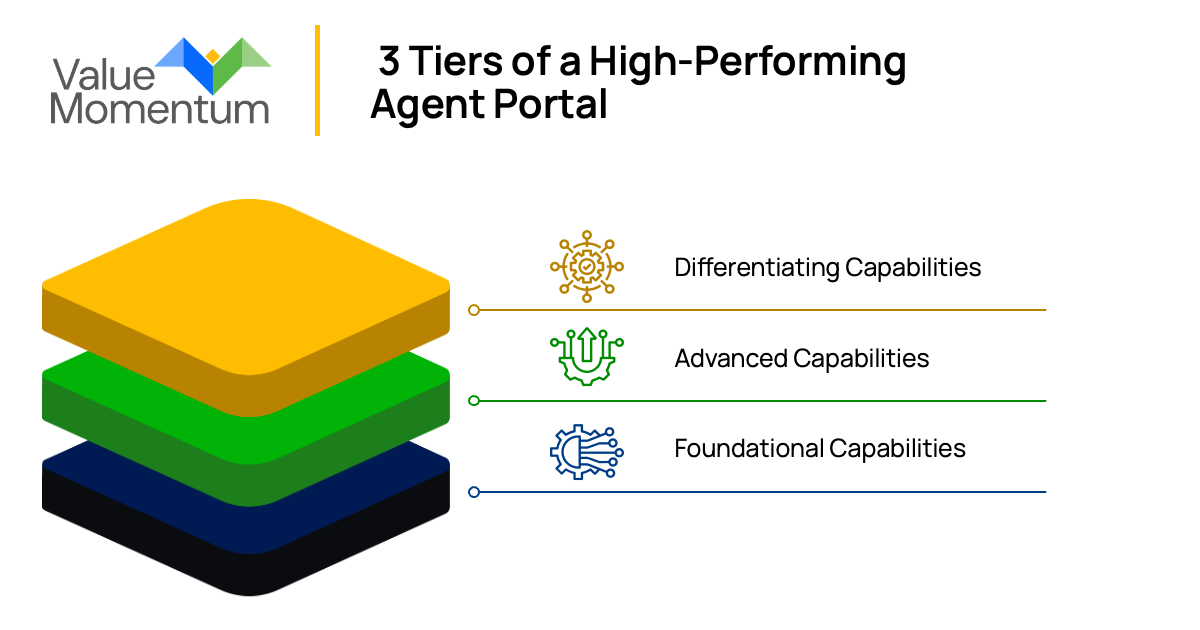
The 3 Tiers of a High-Performing Agent Portal
The question for carriers is not whether to invest in the agent portal, but where to invest first and how to sequence the build. That is where a capability framework becomes useful.
Rather than trying to adopt every capability at once and ending up with a fragmented experience that does nothing well, P&C insurers should think in tiers.
These tiers start with the foundational capabilities that every competitive portal must have, move on to advanced capabilities that meaningfully improve agent productivity, and end with differentiating capabilities that set a carrier apart in a crowded field.
Foundational Capabilities
Foundational capabilities are the baseline. Agents expect them, and their absence creates immediate friction that affects placement decisions.
At the profile level, this means accurate agent hierarchy management, affiliation tracking, and clearly defined primary underwriter relationships. For submissions, it means a clean digital submission path — exposure and location data, coverage and limits, quote generation, and premium payment — without requiring agents to navigate back-office systems not designed for them.
One regional mutual carrier discovered this problem firsthand when a core system migration routed agents directly into a policy administration interface designed for internal underwriters. Agents encountered complex navigation, generic error messaging, and redundant data entry at every turn. Addressing those foundational gaps, such as streamlining the question set, improving error transparency, and introducing data pre-fill, was the first priority before any advanced capabilities could be considered.
At the transaction and inquiry level, foundational capabilities include account and policy views, billing reconciliation, claims status visibility, and access to digital documents and payments. A portal that handles these daily tasks reliably and efficiently is one agents will return to.
Advanced Capabilities
Advanced capabilities are where portals move from functional to genuinely productive. They not only enable transactions, but also reduce the cognitive load on agents and make interactions with a carrier meaningfully faster and more informed.
On the submission side, this means moving beyond manual data entry with pre-fill wherever possible, which can help agents generate quotes more rapidly, rather than re-entering all submission data field by field. STP for underwriting approval on qualifying risks belongs here as well, removing the need for human intervention on submissions that clearly fall within appetite. For servicing, advanced capabilities include endorsements, renewals, and notes, which together make up a large share of an agent’s daily workload but are frequently deprioritized in favor of new-business functionality.
One area carriers consistently underinvest in is claims visibility. Agents do not need access to the full claims file, but they do need to know a claim’s status when a policyholder calls. Providing that visibility within the portal, rather than requiring a phone call to a claims representative, is a straightforward investment that pays dividends in agent satisfaction and contact center deflection.
Advanced capabilities at the dashboard level include portfolio views by product and state, billing summaries, and commission tracking. These give agents the business intelligence they need to manage their book with a carrier, and they signal that the carrier is invested in the agent’s success — not just the next transaction.
Differentiating Capabilities
Differentiating capabilities are what separate carriers that agents prefer from carriers that agents merely use. They are not universally available, and their absence is increasingly noticeable as more carriers invest in advanced portal functionality.
The most impactful differentiator is intelligent appetite guidance. Rather than providing agents with generic eligibility rules, leading carriers are building dynamic appetite services that tell agents specifically whether a risk is likely to be written before they invest time in a full submission. This reduces wasted effort on both sides and builds agent confidence that the carrier’s portal is worth returning to. Similarly, virtual assistants can answer appetite questions, surface product information, and guide agents through complex submissions in real time, without requiring a call to an underwriter.
Differentiating capabilities in submissions include the ability to submit via multiple pathways, such as a full digital submission, an uploaded ACORD form, or a prior carrier declarations page, giving agents flexibility to work the way they already work rather than conforming to a single carrier-defined process. Bind and issue functionality, cancellation handling, and first notice of loss initiation round out the submission tier for carriers operating at the leading edge.
Perhaps the most strategically valuable differentiating capability is the intelligent workspace: a dashboard that goes beyond static reporting to surface actionable insights. Which accounts are up for renewal and at risk? What is the propensity of a given lead to close? How are commissions tracking against target?
Carriers that answer these questions within the portal are not just providing a transactional tool but are becoming a genuine business partner to the agents they work with. That is the standard that earns preferred carrier status.
Building to this standard does not happen in a single initiative, but carriers that approach portal development with a deliberate, tiered investment strategy will find that each capability they add makes the next one more valuable.
Building an Insurance Agent Experience for the Future
Agent experience is now a primary growth lever, not just a secondary consideration for carriers that distribute through independent agents. The carriers investing in portal capabilities today are building relationships that are genuinely difficult for competitors to displace. Those that are not will find it increasingly difficult to hold mind share of an agent’s portfolio of 15-plus carrier relationships.
This three-tier framework is a starting point, not a checklist. Carriers do not need to build everything at once, but they do need a clear view of where they stand, where the gaps are, and what the roadmap looks like. Want to go deeper on what modern agent portal development looks like in practice? Watch our on-demand webinar, Ask the Experts: Modern Agent Portals — Elevating Experience and Driving Profitable Growth.