

Independent agents remain the dominant force in U.S. property and casualty (P&C) insurance distribution. According to the Big “I” 2025 Market Share Report, independent agencies placed 61.5% of all P&C premiums written in the United States in 2024 — including 87% of all commercial lines business. For personal lines, their share has grown steadily over the past five years, reaching 39% in 2024.
Yet the J.D. Power 2025 U.S. Independent Agent Satisfaction Study found that just 56% of personal lines agents and 57% of commercial lines agents say carriers are meeting their foundational needs. One in four personal lines agents does not feel valued as a partner.
Among commercial lines agents who feel undervalued, J.D. Power found they are seven times more likely to reduce the volume of business they write with that carrier in the following year. Agent experience is increasingly the variable that determines which carriers make that list.
The Optimal Agent Experience for P&C Insurance
Agent portals have often been designed around carrier workflows rather than how agents do business. The result is interfaces that are technically functional but operationally cumbersome — too many fields, unclear error messages, no pre-fill, and navigation built for back-office users rather than producers trying to close a quote in a client meeting.
When carriers work closely with agents to understand how they actually operate, a consistent set of requirements emerges:
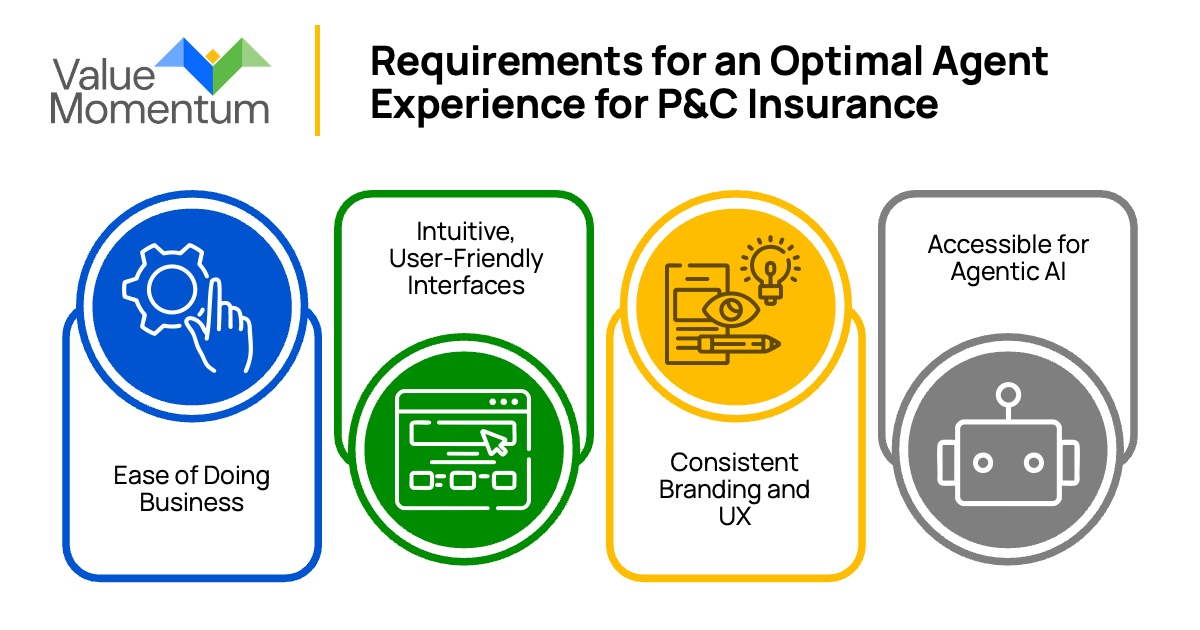
Ease of Doing Business
“Ease of doing business” encompasses the full relationship: new submissions, endorsements, renewals, document access, and carrier communication. Carriers that reduce friction at every touchpoint accumulate a meaningful advantage over those that require agents to call in for routine transactions or navigate separate systems for separate functions.
Agents need to know quickly whether a risk fits a carrier’s appetite and what the indicative price will be. Extended turnaround times push agents toward carriers that can answer faster. Straight-through processing (STP) for standard risks lets agents quote and bind without waiting. For accounts that don’t qualify for STP, clear, immediate feedback on why a risk doesn’t fit is nearly as valuable as a fast yes.
Carriers that still require agents to use separate systems for new business and service are creating friction that compounds with every transaction. The ability to quote, bind, issue, endorse, and renew without toggling between systems is increasingly treated as table stakes rather than a differentiator.
Intuitive, User-Friendly Interfaces
A technically capable portal that is visually cluttered or logically disorganized adds friction to every interaction. Agents working across multiple carrier portals develop strong preferences for those that surface the right information at the right time, minimize the number of steps to complete a transaction, and behave consistently across different lines and workflows.
Interface design is not merely cosmetic; it directly affects how much business an agent can process in a day and how many errors make it into submissions. Even feature-rich portals become obstacles when the architecture is unclear.
Role-based navigation that surfaces different pathways for different agent types — new business producers versus account managers handling renewals, for example — significantly reduces cognitive load and submission error rates. Agents under time pressure need to find what they need immediately; a portal that requires exploration loses to one that doesn’t.
Consistent Branding and UX
Agents form perceptions of a carrier’s professionalism and stability from the tools they use daily. A portal that is well-designed, modern, and responsive signals that the carrier is committed to making the relationship work, and that signal carries weight when agents are deciding where to place their next account.
But agent portals need to reflect the insurer’s brand consistently with other points of interaction. Embedded offerings through partner sites or apps, customer portals, and the corporate website should align with the branding and UX agents are seeing.
Agents are a critical component of how most P&C insurers do business. If they feel that their touchpoint with an insurer is out of date or an afterthought due to branding or UX issues, carriers are going to lose business in the long run.
Accessible for Agentic AI
AI agents are increasingly playing a role in mediating insurance distribution. P&C carriers who do not invest in a digital infrastructure that agentic AI can access will be left behind by insurers who are built to scale. For standard lines of business, both personal and commercial, agentic AI will only play a bigger role in the way insurance is bought.
Industries like retail are already leveraging agentic AI to streamline the browsing and purchasing process for consumers. AI agents can search for coverage options, compare various offerings to the consumer’s needs, and even purchase a policy independently. They can also serve as intermediaries for humans and other agents working with different carriers, subsidiaries, or partner organizations, helping bring new partner offerings or bundled services to light.
Insurers need to prepare for this by ensuring that their websites and portals are readily providing these agents with the information needed to assess what coverage types a carrier offers, pricing and geographic information, and how a purchase is executed.
Carriers that get these elements right not only improve satisfaction scores; they also change placement behavior. When agents find a carrier easy to work with, they are more likely to reach out to that carrier first and just as likely to continue doing business with that insurer.
Experience Modernization in Practice
The path to a better agent experience looks different depending on a carrier’s distribution model, the lines of business it serves, and its strategic goals.
The following examples illustrate two distinct approaches — one focused on redesigning a traditional independent agent portal, the other on building a modern digital distribution platform for specialty brokers.
- Redesigning the Traditional Agent Portal
A 100-year-old insurer with a distribution model exclusively leveraging independent agents undertook a comprehensive agent portal modernization after completing a major core system migration. While the insurer had migrated to the cloud, it had not addressed its agent experience.
Agents were routed directly into the policy admin system, a back-office system designed for internal users, not producers. The results were predictable: complex workflows, generic error messages that provided agents with no actionable information, and too many data fields requiring agents to provide information the system should already have.
Alongside ValueMomentum, the insurer took a structured approach to understanding and redesigning the agent experience. Its team developed four distinct agent personas to understand how different types of agents — with different books of business, different levels of technical comfort, and different workflow needs — were actually using the portal.
From there, they focused on three priorities:
- STP for standard risks
- Accurate data pre-fill to reduce redundant data entry
- Transparent error messaging that told agents specifically what was wrong and how to correct it.
The company also established a structured feedback group composed of agents with diverse profiles, to ensure ongoing input from the field as the portal evolved.
As a result, the agent experience score improved 10 percentage points, and the company set a goal of achieving a 30% increase in quote-to-bind ratio as portal adoption expanded. The insurer now ties agent experience scores directly to written premium growth when building the business case for continued investment, a framing that connects operational improvements to financial outcomes in a way that resonates with executive leadership.
2. Building a Modern Digital Distribution Platform
A specialty carrier focused on cyber liability and professional lines faced a different version of the same challenge. Competing against insurtech-native players with modern digital distribution infrastructure, the insurer needed to provide brokers with a self-service experience that matched what more digitally advanced competitors were offering.
Working with ValueMomentum, the company built an integrated digital distribution platform that consolidated a broker portal, partner APIs, and an underwriting portal into a single modern environment. Brokers gained the ability to generate quotes and bind policies 24/7 through whichever digital channel best suited their workflow.
The platform also incorporated underwriting guidance to help brokers understand appetite and the impact of underwriting responses in real time, reducing back-and-forth with underwriters and improving submission quality. For the carrier, the platform enabled rapid updates to rating and underwriting rules without IT dependencies, reduced staff workload for transactional tasks, and improved pricing accuracy through better data integration.
Carriers that have invested in the agent experience are seeing the results in placement behavior and premium growth. The question for carriers is not whether to modernize, but how quickly the cost of inaction will show up in their book of business.
To learn more about how to deliver an optimal insurance agent experience, check out our on-demand webinar, “Ask the Experts: Modern Agent Portals: Elevating Experience and Driving Profitable Growth.”