
Claims organizations are facing new levels of pressure as indemnity costs rise, fraud grows more sophisticated, and customer expectations accelerate. Even insurers that have made steady technology investments are discovering that incremental improvements aren’t enough to stay ahead with today’s rapidly evolving claims environment.
Across the industry, claims modernization efforts are underway, but progress remains uneven. Some carriers have advanced digital workflows, AI-assisted processes, and streamlined operating models, while others continue to rely on fragmented systems or manual steps that restrict scale and consistency.
As these gaps widen, the ability to assess where a claims organization truly stands has become essential.
Understanding Today’s Claims Pressures and Maturity Gaps
The case for claims modernization is clearer than ever. Rising cost pressures, growing fraud complexity, and increasing demand for digital-first experiences are stretching traditional operating models beyond their limits. Recent findings from J.D. Power show that digital interactions now play a central role in shaping customer satisfaction, reflecting growing expectations for intuitive digital tools and proactive communication.
Cost pressures are intensifying as well. The Swiss Re Institute reports that liability claim severity in the U.S. continues to rise sharply due to social inflation and higher litigation costs — a trend that is outpacing general economic inflation and placing additional pressure on claims organizations to improve efficiency and control.
According to ValueMomentum’s The State of Claims Maturity in P&C Insurance 2026, many carriers are making progress, but modernization remains uneven as organizations balance legacy constraints, fragmented processes, and evolving customer needs. Readiness also varies significantly across the industry. Larger carriers often have the scale and budget to advance more quickly, while midsize and smaller organizations tend to modernize through targeted or incremental improvements.
Regardless of starting point, every insurer faces the same fundamental question: How well is the claims organization positioned to adapt, improve, and compete in a rapidly changing environment? Answering that question requires a structured approach. The following steps outline how insurers can both assess their current level of claims maturity and identify the areas that will deliver the greatest operational impact.
How to Gauge and Advance Claims Maturity
Modernizing claims begins with understanding where the organization stands today. The steps outlined below reflect the progression insurers typically follow as they advance toward higher levels of claims maturity.
By taking a systematic approach to reviewing workflows, technology, and decision-making patterns, insurers can uncover the root causes of leakage, delays, or inconsistencies and identify the improvements that will deliver the greatest impact.
The following steps outline a structured approach to understanding your claims organization’s maturity and determining where to focus next.
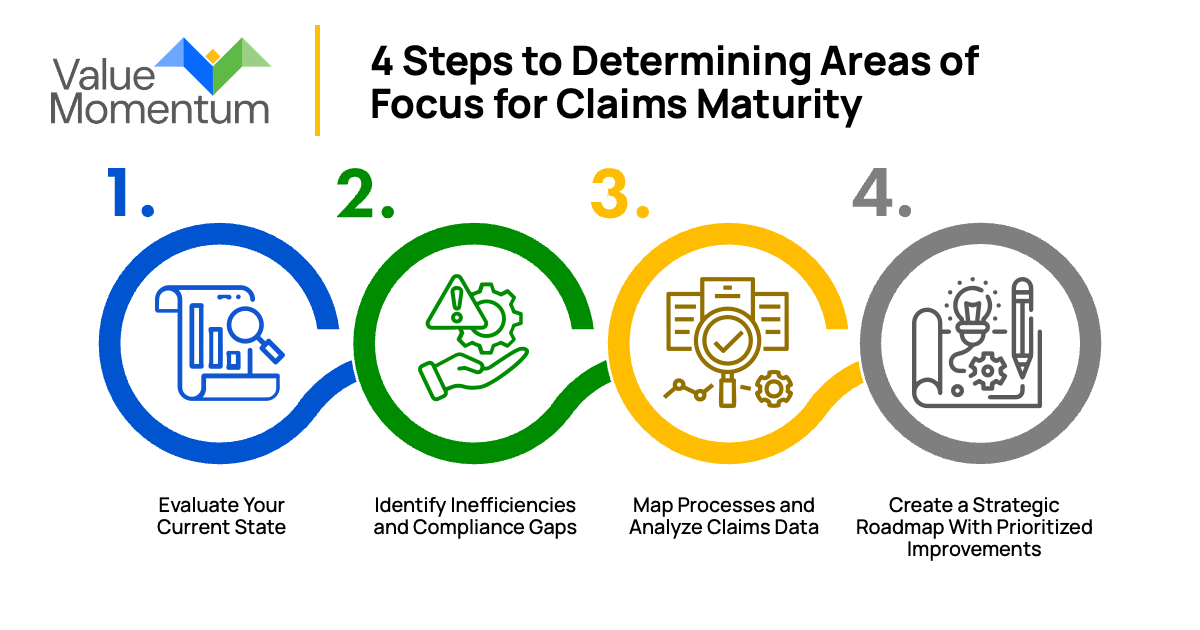
1. Evaluate your current state
A maturity assessment begins with a detailed review of the claims environment, including workflows, which systems support processes, and which policies guide adjuster behavior. Examine legacy dependencies, the role of manual workarounds, the complexity of rules and procedures, and the effectiveness of controls embedded in daily operations.
Many insurers find that issues such as inconsistent documentation, disconnected intake channels, or even siloed systems create more variation than they realize. Understanding these structural elements establishes a baseline for identifying the root causes of performance challenges and inefficiencies.
2. Identify inefficiencies and compliance gaps
Once foundational processes are documented, the maturity assessment focuses on where work slows down or deviates from expected standards. This includes analyzing sources of leakage, compliance exposures, recurring error patterns, and the workload distribution across adjusters and teams.
Inefficiencies may stem from tasks that require repeated handoffs, unclear decision points, high-touch manual reviews, or insufficient access to timely data. By systematically examining these friction points, insurers gain a clearer view of the operational and financial risks that impact outcomes and the areas most suitable for targeted improvement.
3. Map processes and analyze claims data
Mapping the end-to-end claims flow allows insurers to see not only how processes are designed, but also how they actually operate. Through cycle-time analysis, file reviews, and data quality assessments, insurers can uncover trends that influence everything from accuracy and cost to timeliness.
Stakeholder interviews also play an important role here, giving leaders insights into barriers that adjusters face every day, such as outdated tools, system limitations, or inconsistent guidance. Lastly, benchmarking against industry performance adds an additional layer of context, revealing whether delays, leakage, or outcome variation are isolated issues or signs of broader structural challenges. This step translates anecdotal observations into quantifiable evidence.
4. Create a strategic roadmap with prioritized improvements
The final step involves creating a modernization roadmap that focuses on initiatives with the highest impact and strongest organizational readiness. This includes identifying opportunities for:
- Workflow redesign,
- Automation,
- System integration,
- AI-enabled assistance,
- Simplified controls,
- Training enhancements, and
- Improvements in vendor or performance management.
Prioritization frameworks help determine which improvements are feasible quickly — including digitizing intake, standardizing communications, or introducing guided workflows — versus those that require longer-term transformation, such as platform upgrades or operating model redesign. A strong roadmap also secures alignment across claims, IT, and business stakeholders, ensuring that modernization efforts can both scale and last over time.
By grounding modernization efforts in a structured, phased approach, carriers can prioritize improvements based on impact, address issues that contribute to leakage or inefficiency, and ensure that investments support long-term performance. This level of clarity helps leaders move forward with confidence as they build a more resilient, data-driven, and customer-focused claims function.
Positioning Claims for Long-Term Success
As claims organizations navigate rising costs, increasing complexity, and higher customer expectations, the ability to assess readiness has become just as important as the tools and technologies used to modernize. Understanding where the organization stands and which improvements will have the greatest operational and customer impact enables insurers to modernize with purpose.
With a clearer view of strengths, gaps, and opportunities, carriers can chart a modernization path that strengthens accuracy, reduces leakage, improves cycle times, and builds a more resilient claims organization. Those that invest in structured assessment and targeted improvement will be better positioned to respond to market pressures and deliver the level of performance and transparency that policyholders now expect.
Interested in learning more about how to modernize claims? Read our report The State of Claims Maturity in P&C Insurance 2026 to learn what a mature claims organization looks like and how to chart your path forward.