



Commercial lines product content management presents a different challenge than in personal lines. Homeowners and personal auto are typically high volume and fairly standard. Commercial lines products, on the other hand, are often heavily customized and require a different level of underwriting. This means commercial lines insurers are tasked with keeping coverages, endorsements, exclusions, rates, rules, and forms current across multiple lines of business and states.
Failing to stay up to date in all of these areas can have major consequences, such as losing a competitive edge, slowing new business growth, decreasing retention rates, exposing the carrier to compliance risk, suffering a rating downgrade, and experiencing eligibility restrictions in certain market segments. For carriers looking to expand into new states or launch new lines of business, an already-strained product content process becomes a direct obstacle to growth.
How Product Content Management Creates a Competitive Advantage
Managing product content in commercial lines requires more than keeping up with a backlog of product changes. The admitted market imposes a specific set of obligations across every state and line of business a carrier writes: rates, rules, and forms filed with state commissioners, updated on regulatory timelines, and subject to examination.
Carriers who turn product content management from an afterthought into a strategic process can stay ahead of market shifts and steer their product decisions to better shape their competitive position.
Here are three critical ways that insurers can directly translate strategic product content management into business performance.
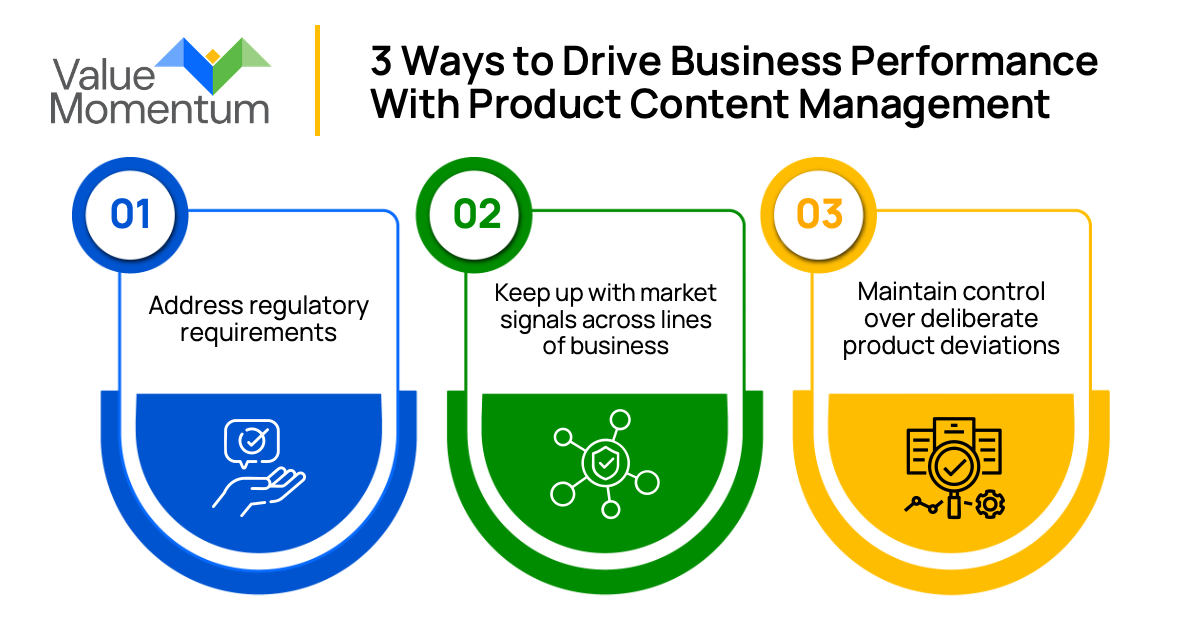
1. Address Regulatory Requirements
Admitted commercial lines carriers operate under a compliance obligation that is both continuous and consequential. Bureau circulars arrive on rolling schedules, each carrying its own adoption window and state-specific applicability. Carriers that fail to act within those windows risk falling out of compliance, which can trigger regulatory fines, credit rating downgrades, and restrictions on writing business in certain market segments.
Most carriers track incoming circulars at some level. But without a well-defined strategy that includes triaging, prioritizing, and executing circular updates across business lines and states, adoption work accumulates into a backlog that grows faster than teams can address it. What begins as a manageable backlog can become a years-long deficit, exposing carriers to the very compliance consequences they set out to avoid.
A structured product content management approach closes that gap by treating regulatory adoption as an ongoing discipline rather than a project. It establishes a cadence for circular review, a methodology for assessing impact across the book, and a clear path from triage to implementation, giving carriers the operational infrastructure to meet their compliance obligations consistently and on schedule.
2. Keep Up With Market Signals Across Lines of Business
Commercial lines are not a monolith. General liability, commercial auto, property, workers’ compensation, and inland marine each carry distinct exposure profiles, loss trends, and bureau content requirements. In addition, market conditions across those lines can shift at different speeds and in different directions.
At a recent McKinsey commercial lines gathering, executives broadly agreed that agility has become the most significant differentiator for carriers navigating today’s market. Yet agility depends on more than market awareness. A carrier can monitor competitor filings, track loss ratio trends, and identify signals that coverage terms or underwriting standards need to change, but none of that translates into an advantage if the organization does not have the operational capacity to act on those signals.
Carriers need to evaluate the impact of product content change on critical factors like business growth, direct written premium (DWP), retention, and underwriting effectiveness. Product changes resulting from bureau circulars or carrier decisions need to be implemented at the first opportunity to leverage the benefits of early adoption.
When product content work is backlogged or embedded in teams without a dedicated cadence, the gap between knowing and doing widens. Carriers in that position may recognize a change is warranted months before they can execute it, ceding the timing advantage to competitors who moved faster. A disciplined product content management approach positions carriers to act on market signals rather than simply observe them.
3. Maintain Control Over Deliberate Product Deviations
Not all carriers adopt bureau content all the time. Many of them file on a reference basis, selectively accepting or rejecting individual circulars and layering proprietary modifications on top of standard bureau content to reflect their own risk appetite and market positioning. These deviations are not exceptions to a carrier’s product strategy but an expression of it.
The operational challenge is that deviations accumulate over time. A decision made during one circular adoption cycle — to reject a particular form change or defer a coverage update, for example — may be entirely defensible in context.
Without a system for tracking and revisiting those decisions, however, what was once a deliberate strategic choice can become an unexamined liability. Regulatory environments shift, claims trends evolve, and coverage language that once served a carrier’s interests may no longer do so. Carriers that lack visibility into their own deviation history are poorly positioned to recognize when that has happened.
A disciplined product content management approach brings that visibility into the process. By maintaining a documented record of deviation decisions, such as what was modified, why, and under what market conditions, carriers can evaluate their product positions with the same rigor they apply to new adoption decisions. The result is a product portfolio that reflects current strategy rather than accumulated history, and a compliance posture that can withstand regulatory scrutiny at any point in the cycle.
Carriers consistently outperforming across market cycles don’t simply know the market best. Instead, they have the operational discipline to act on what they know.
Turning Knowledge Into Action
The commercial lines market rewards carriers that can move with precision and speed to adjust coverage terms as conditions shift, stay current with bureau requirements across every state they write, and more. But that isn’t possible when product content management is treated as a secondary obligation and updated on an ad hoc, infrequent, or as-needed basis.
Structuring product content management as a life-cycle discipline gives carriers what reactive maintenance never can: the operational foundation to close the gap between market intelligence and market action. It allows carriers to stay compliant and competitive at the same time, directly impacting business growth, DWP, loss control, and, most importantly, combined ratio.
To learn more about how carriers are driving value by streamlining forms-intensive processes, read our case study “Specialty Insurer Launches Underwriting Workbench for Streamlined Submission Process.”