

For many UK commercial and specialty lines underwriting teams, the challenge starts well before risk evaluation with simply understanding what has been submitted. A single placement might arrive as a mix of PDFs, spreadsheets, scanned questionnaires, certificates, emails and site photos. Even then, completeness and consistency are far from guaranteed, often leading to gaps in understanding and insight.
The latest figures show that underwriters still devote around 30-40 percent of their time to administrative tasks such as normalising documents, re-keying data and reconciling fields across systems. The result is slower decision-making and reduced profitability. This is where AI-enabled insurance submission triage can play a role.
In a market where broker relationships and timely responses drive success, the ability to move at pace impacts profitable growth. AI can help ease this pressure and complement, rather than replace, the expert judgement of human underwriters.
Structural challenges drive inefficiencies
Despite advances in underwriting technology, several challenges continue to slow progress. Nearly half of London Market firms identify data fragmentation and unstructured formats as major barriers to efficiency and automation. Governance and data integrity are also under scrutiny. For example, the Prudential Regulation Authority fined MS Amlin Underwriting Limited £9.7 million for weak underwriting governance controls, showing how seriously regulators view poor oversight.
Another challenge lies in integrating intake workflows with underwriting and policy administration systems (PAS). Many teams still move between inboxes, shared drives, underwriting workbenches and PAS platforms, requiring information to be re-entered or manually reconciled. As London Market carriers, particularly in marine, cyber and E&S, face more than a thousand submissions each week, even mature operational models are stretched.
While these challenges are significant, with a focused approach to their underwriting and submission strategy, insurers can combat these obstacles and enhance their operational efficiency.
A practical path to AI-enabled submission triage
Underwriting submission triage AI streamlines the front end of the process by taking on the work that usually slows teams down. The system ingests whatever comes in, from emails to broker uploads, and pulls out the key information so each submission starts in a consistent, structured format. Once the essentials are captured, basic rules and appetite checks run automatically, highlighting gaps, surfacing anything that looks unusual and creating the submission record so it can be routed to the right underwriter without delay.
More advanced setups add a second layer of analysis. Here, AI reviews the submission in more depth, drawing on previous account history and relevant guidance to form a simple, evidence-backed view of what the risk looks like and how urgent it is. The output is a clear picture of the submission and its priority, giving underwriters a reliable starting point instead of a mix of unstructured documents.
The impact of this approach is already clear in the market. Hiscox, for example, has worked with Google Cloud to deploy a generative-AI-powered underwriting model for its sabotage and terrorism line. The proof of concept reduced the time from submission to quote from around three days to just three minutes.
Insurers do not need to overhaul their entire underwriting platform to begin realising the value of AI. The most effective programmes start with a focused triage layer that sits between submission intake and underwriting decisioning.
A best-in-class approach follows three simple, high-impact steps:
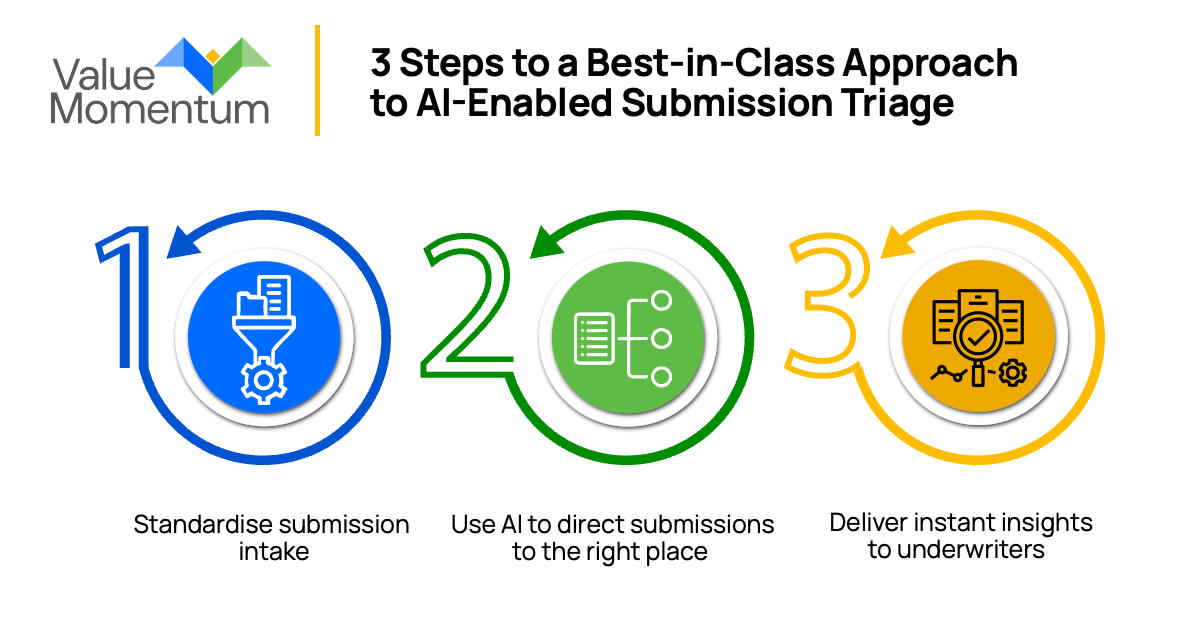
1. Standardise submission intake.
The first step is to make sense of the submissions themselves. An AI intake agent now handles this work by reading whatever comes in, pulling out the essentials, spotting gaps or inconsistencies and creating a clean record in the workbench.
It can extract key fields such as insured details, limits, exposures and loss runs; classify the submission by line of business and risk type; flag missing information and auto-create the submission record in the underwriting workbench or PAS. This gives underwriters a consistent, reliable starting point instead of a pile of unstructured documents.
2. Use AI to direct submissions to the right place.
Once the submission has been cleaned up, it moves into a more intelligent triage stage. Here, a triage agent blends underwriting rules, appetite cues and contextual insight to understand what the submission represents and how urgent it is.
It pulls in the relevant guidance in the background, checks whether the information is complete and aligned with appetite and brings any concerns to the surface, such as a difficult loss pattern or signs of financial strain. It also looks back at any previous history with the account to give the underwriter proper context.
All of this comes together in a simple score that explains whether the submission is low, medium or high priority and directs it to the right underwriter. The result is a smoother workflow where underwriters spend their time on the cases that matter most and brokers receive quicker, more consistent responses.
3. Deliver instant insights to underwriters
The final step is to turn the output of triage into something an underwriter can use straight away. For each submission, AI assembles a short evidence pack that brings the key points together in one place. It lays out the essential facts about the insured, highlights the relevant metrics, and draws attention to anything that may need a closer look.
It also pulls in the parts of the guidelines that apply and suggests where the risk sits in terms of appetite. Links back to the original documents are included for easy reference. This provides underwriters with the context and clarity they need immediately, eliminating time spent searching through documents and reconstructing information manually.
This approach delivers early wins, supports underwriter adoption and builds the foundation for a broader transformation. In fact, BCG has found that applying AI to manual underwriting workflows can improve efficiency for more complex products by up to 36%. Submissions arrive in better shape, with errors flagged early and risks grouped more consistently. Teams spend more time on in-appetite opportunities, hit ratios rise and broker conversations become faster and more dependable.
Paving the way for better underwriting
AI-enabled insurance submission triage is not about removing the expertise or judgement of human underwriters. It is about simplifying underwriting workflows so underwriters can apply their judgement more effectively.
By standardising intake, reducing manual effort and improving prioritisation, insurers can increase capacity, consistency and underwriting quality while delivering a faster, smoother broker experience. Once the triage layer is in place, it also scales across lines and channels without matching increases in staff and creates the foundation for broader AI support, from richer risk insight to pricing guidance and renewal intelligence.
See how one insurance provider leveraged AI to achieve more efficient and effective underwriting in our case study “Specialty Insurer Launches Underwriting Workbench for Streamlined Submission Process.”