

Insurance organizations are accelerating software delivery to support business imperatives like cloud modernization and evolving customer and agent experiences. But technology leaders are under pressure to deliver these capabilities without increasing operational risk or enabling security or compliance gaps. As release cycles shorten and hybrid environments become more common, development pipelines themselves are becoming increasingly complex to govern and secure.
Investment in DevSecOps continues to accelerate to address the risk associated with meeting these business goals. The global market is projected to more than double by 2030 as enterprises prioritize integrated, security-first delivery models.
AI-powered DevSecOps helps insurers respond to these pressures by embedding security, quality, and operational intelligence throughout the software development life cycle. Rather than bolting security on at the end, this approach enables earlier issue detection while building in consistent governance practices.
Why Insurers Are Moving Toward AI-Powered DevSecOps
As insurance organizations modernize core platforms and expand digital capabilities, the pace of delivery itself has become a strategic concern. Faster releases are essential for competitiveness, but they also amplify weaknesses in how software is built, tested, and operated. Traditional DevOps approaches often struggle to keep up, particularly in hybrid and multi-cloud environments that invariably come with inconsistencies.
These challenges directly affect time to market and risk exposure, forcing insurers to rethink their development practices. Several recurring issues are driving insurers toward AI-powered DevSecOps models:
- Delivery speed without consistent controls. Agile, product-based delivery has increased deployment frequency across insurance portfolios. However, many organizations still rely on legacy release processes, manual approvals, or inconsistent pipeline enforcement. Quality and security checks are often applied unevenly, creating bottlenecks that slow releases or introduce risk late in the life cycle. The result is a persistent tension between speed and control, where teams are forced to choose between moving fast and maintaining confidence in outcomes.
- Security not embedded by design. In many delivery environments, security remains a downstream activity. Static scans and compliance checks occur late, secrets persist in code repositories, and container security is inconsistently enforced. When vulnerabilities surface late, remediation becomes more expensive and disruptive — often delaying releases or increasing operational risk. This reactive posture makes it difficult for insurers to scale delivery while meeting security and regulatory expectations.
- Infrastructure and tooling complexity. Hybrid and multi-cloud architectures introduce additional operational overhead. Manual provisioning, fragmented tooling, and non-ephemeral environments all contribute to reduced consistency across teams and portfolios. As delivery ecosystems become more fragmented, enforcing shared standards and governance grows increasingly difficult, especially at scale.
Rather than relying on isolated tools or late-stage reviews, AI-powered DevSecOps enables insurers to standardize delivery practices, detect issues earlier, and operate at scale without sacrificing control. To realize these benefits consistently, insurers must move beyond incremental improvements and adopt a practical approach to implementing AI-powered DevSecOps across the delivery life cycle.
How to Implement AI-Powered DevSecOps
Employing AI-powered DevSecOps is less about adopting a specific toolset and more about evolving how delivery, security, and operations work together over time. The following steps illustrate how insurers can embrace DevSecOps and move toward a more mature, life-cycle-aligned execution model.
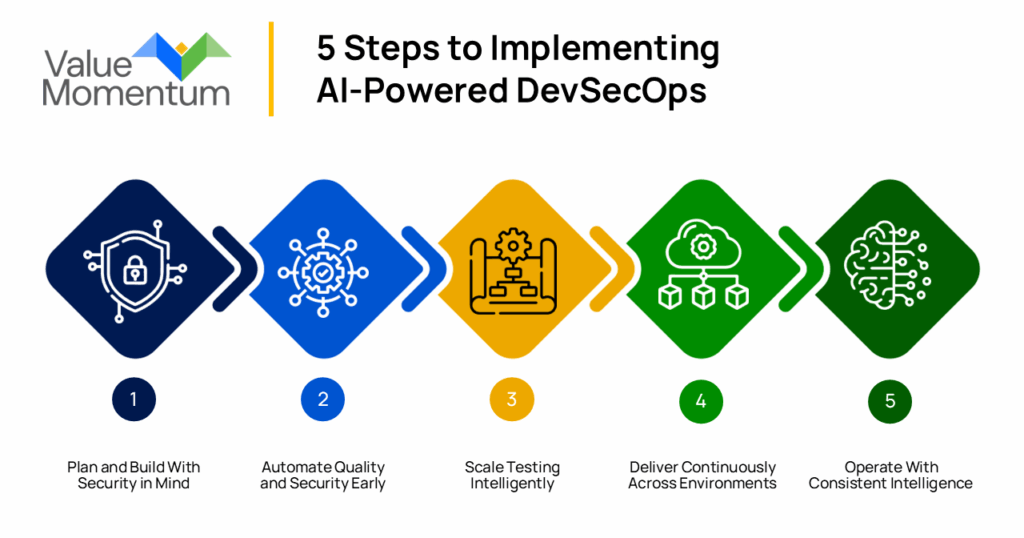
- Plan and Build With Security in Mind
Consider a midsized property and casualty insurer modernizing its claims platform to support faster releases and new digital features. Security and compliance considerations are incorporated early on into backlog prioritization, architecture decisions, and environment planning rather than deferred to release approvals.
By identifying higher-risk changes earlier, delivery teams reduce late-stage remediation and avoid release delays driven by downstream findings. This early alignment creates a shared understanding of risk tolerance and delivery priorities across product, engineering, and security teams. - Automate Quality and Security Early With Continuous Integration
As development velocity increases, the insurer embeds automated quality and security checks directly into its continuous integration pipelines. Static analysis, dependency scanning, and secrets detection are enforced consistently at commit and pull-request stages, with AI-assisted insights helping teams focus on the most relevant issues.
These automated controls reduce variability across teams and portfolios, allowing security and quality standards to scale without increasing manual review overhead. - Scale Testing Intelligently
With baseline automation in place, continuous testing expands beyond basic validation. AI-assisted test generation and prioritization enable broader functional, regression, and security testing while keeping cycle times manageable. Rather than testing everything equally, teams focus their efforts on areas where changes introduce the most risk.
This approach lets the insurer maintain confidence in release quality as deployment frequency increases, without reverting to slower, manual testing processes. - Deliver Continuously Across Environments
To support a mix of legacy systems and cloud-native services, the insurer standardizes deployments using Infrastructure as Code and automated release pipelines. Environments can be provisioned and retired on demand, reducing configuration drift and simplifying governance across on-premises and cloud platforms.
Intelligent deployment strategies, such as phased rollouts, help minimize risk while supporting more frequent and predictable releases. - Operate With Consistent Intelligence
Finally, operational feedback is integrated back into the delivery life cycle. AI-powered monitoring and incident detection improve visibility across builds, deployments, and runtime behavior. Operational insights then inform future planning decisions, pipeline optimizations, and security controls.
By closing the loop between delivery and operations, the insurer moves from reactive issue management toward continuous improvement — strengthening resilience without slowing innovation.
As demand for digital delivery continues to rise, insurers face growing pressure to move faster without increasing operational risk. AI-powered DevSecOps addresses this challenge by embedding automation and visibility directly into the development process. By incorporating security and quality earlier, organizations can standardize delivery practices and maintain release velocity while preserving governance and reliability.
The outcome is a more predictable and resilient delivery model that supports ongoing enhancements across the insurance technology landscape. As AI capabilities are embedded into delivery and operations, insurers improve visibility into risk and performance, enabling faster modernization and more confident responses to change.
To learn more about how insurers are driving growth with cloud investments, read our case study, “Super-Regional Carrier Accelerates Commercial Lines Business Growth With Guidewire Cloud Platform.”