

Social inflation is reshaping the liability landscape in ways that traditional claims and reserving models were never built to absorb. Litigation is becoming more frequent, more complex, and far more expensive. And the pressure continues to accelerate. According to the Swiss Re Institute, social inflation added an estimated 7% additional claims growth to U.S. liability lines in 2023 alone, driven by factors unrelated to economic inflation.
At the same time, plaintiff outcomes are improving. Between 2010 and 2019, plaintiff win rates rose from roughly 53% to 64%, reflecting a legal environment increasingly favorable to claimants. Combined with broader interpretations of liability, rising non-economic awards, and more coordinated legal strategies, insurers now face both higher severity and more unpredictable litigation trajectories.
For carriers, the question is no longer whether social inflation will affect performance, but how quickly they can adapt to its effects. Mitigating the impact of social inflation requires a more proactive, analytics-driven, and jurisdiction-aware approach to litigation, supported by stronger organizational alignment and more modern claims practices.
Where Insurers Feel the Impact
Long-standing claims processes are being tested, placing significant strain on actuarial and financial planning. Traditional reserving models, built on historical patterns of claim development, struggle to keep pace with volatility in verdicts and settlement behaviors. As variability increases, the risk of reserve inadequacy rises, with broader implications for portfolio management and pricing strategy.
Legacy claims playbooks and KPIs are falling short when it comes to addressing the increasing impact of social inflation. Adjusters are encountering more complex narratives, better-prepared plaintiffs, and higher expectations in negotiations — conditions that older models were not designed to address. As a result, insurers are seeing the greatest pressure in long-tail and high-severity lines, where even moderate claims can quickly expand into high-exposure events.
As these pressures converge, insurers need a more coordinated, forward-looking strategy that strengthens cross-functional alignment, modernizes litigation approaches, and builds a more proactive, analytics-driven claims operation.
Strategies to Mitigate the Impact of Social Inflation
Mitigating social inflation requires more than incremental process tweaks. Insurers need a coordinated, analytics-driven strategy that brings together claims, legal, actuarial, and risk management teams.
Here are three critical steps carriers can take to reduce severity, improve predictability, and strengthen litigation outcomes.
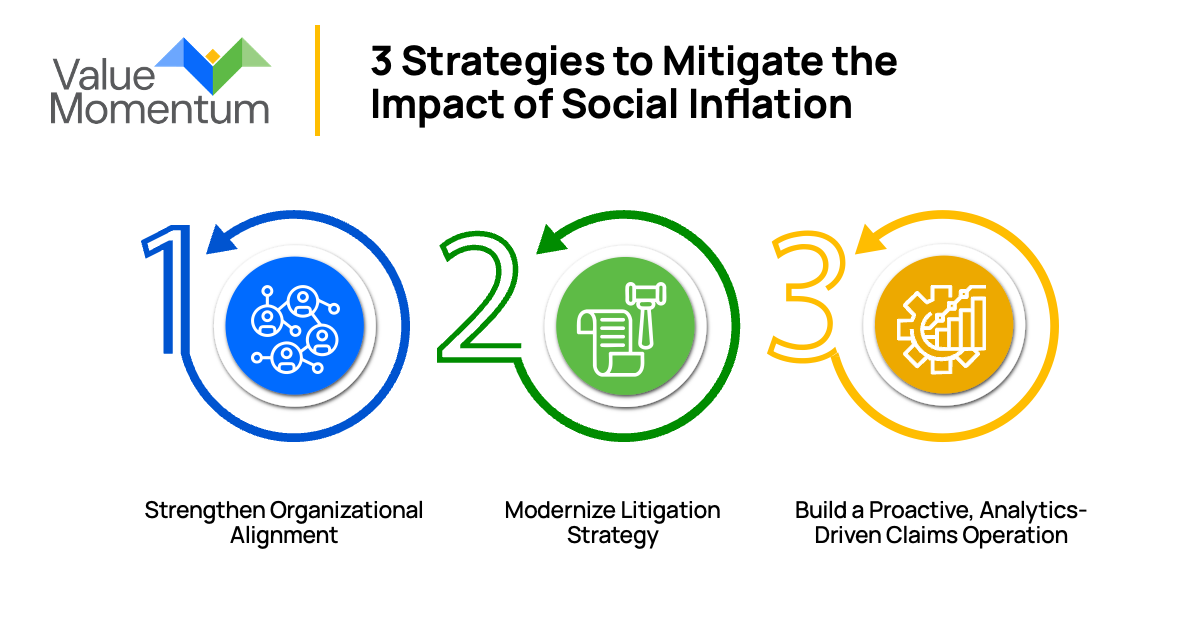
1. Strengthen Organizational Alignment
To combat rising severity and litigation complexity, carriers need tighter coordination across the functions responsible for case strategy, reserving, and financial outcomes. Misalignment between these groups often leads to reserving gaps, inconsistent settlement approaches, and slower recognition of escalation risk.
Insurers should review how they select their legal panel, beginning with a strategy refresh. Evaluate performance through real-world results, efficiency, and quality of resolution rather than relying on long-standing relationships to ensure each case is handled by the right counsel.
On top of this, it is essential to establish clearer communication between claims and actuarial teams as verdict ranges and litigation behaviors become harder to predict. Real-time updates on case developments allow actuarial models to respond faster, improving reserve accuracy and reducing late adjustments. Adjuster training should be adapted to emphasize early issue recognition, venue-specific litigation risk, and stronger negotiation and mediation capabilities to navigate today’s more adversarial landscape.
2. Modernize Litigation Strategy
Traditional litigation frameworks were built for a different era — one with less coordinated plaintiffs, more predictable jury behavior, and fewer sources of external funding. Insurers must evolve how they evaluate venue risks, structure negotiations, and prepare for legal escalation.
Venue dynamics have become one of the most influential predictors of claim severity across liability lines. Developing jurisdiction-specific playbooks that incorporate judge tendencies, historical verdict patterns, plaintiff attorney behavior, and settlement norms helps claims and legal teams approach each jurisdiction with clearer expectations. Similarly, settlement practices rooted in traditional negotiation models are often too slow or too rigid for today’s litigation environment.
Redesign these strategies to incorporate structured settlements, mediation, and other forms of alternative dispute resolution to help resolve disputes earlier and more predictably. Training adjusters and counsel in advanced negotiation techniques and formalizing cross-functional feedback loops can help emerging trends and patterns inform underwriting, reserving, and case strategy in real time.
3. Build a Proactive, Analytics-Driven Claims Operation
Today’s environment requires insurers to have an operating model that can identify issues earlier in the life cycle and reduce severity. Predictive models, document intelligence, and AI-driven triage tools enable insurers to flag high-risk claims earlier and more accurately. These capabilities support better decisions around counsel assignment, reserving, negotiation strategies, and escalation pathways.
Claims severity often begins long before a lawsuit is filed. Strengthening internal and policyholder-facing risk management helps prevent incidents from escalating into litigation. This includes improved safety programs, better communication with insureds, proactive remediation of known risks, and collaborative reviews that draw on both internal experience and industry loss data.
Additionally, stronger governance frameworks help address escalation risks earlier and ensure more disciplined decision-making. Transparency measures such as requiring disclosure of third-party litigation funding and advocating for clearer regulations around attorney advertising can reduce unnecessary legal complexity and limit the number of exaggerated or meritless claims. Internal governance ensures consistent case handling, clearer escalation criteria, and better alignment across legal, claims, and actuarial teams.
Carriers that strengthen these three areas can build the agility and foresight needed to stay ahead of today’s evolving litigation landscape.
Transforming How Insurers Navigate an Evolving Litigation Landscape
Social inflation isn’t a challenge carriers can afford to navigate with legacy playbooks. The litigation environment is shifting too quickly, and the financial stakes are too high. Insurers that foster alignment across their organization, modernize how they approach litigation, and build more predictive, analytics-driven claims operations will be far better positioned to manage severity, improve consistency, and protect profitability.
As these capabilities mature, carriers not only gain greater clarity in decision-making and stronger negotiating leverage, but also a more resilient operating model. And with a more resilient operating model, social inflation can evolve from a source of uncertainty into an opportunity to elevate claims strategy and performance.
To explore more strategies for reducing leakage and improving litigation outcomes, read our whitepaper “Combating Social Inflation: Strategies for Claims Organizations to Reduce Leakage.”