

Customer experience (CX) now shapes whether P&C carriers keep the customers they win. In Invoca’s 2026 Insurance Buyer Experience Report, 89% of U.S. insurance consumers said they would switch to a competitor that responds faster, compared with 79% of consumers across other industries. For carriers counting on retention and cross-sell to fuel growth, that impatience makes experience as much of a growth lever as pricing or distribution.
Insurers know that users now compare the CX a carrier provides against the experiences they use every day from banks, retailers, and their favorite apps. And while many carriers have invested in agent portals and quoting tools, they’ve fallen short when it comes to improving the overall experience that customers have when interacting with their brand.
Building a leading CX requires investing in every customer touchpoint, including the ones policyholders reach on their own. Carriers need to compete on more than price, and the key to doing so is developing a roadmap that views CX as a lasting source of growth and loyalty.
5 Ways P&C Insurers Can Improve Customer Experience
Even after years of digital investment, many policyholders still can’t find what they need online. In Invoca’s 2026 report, 27% of insurance consumers said they called a business because the information they needed wasn’t available online, a figure that has barely moved in three years.
Once carriers have the fundamentals of a strong customer experience in place, the five roadmap elements below help them build something truly differentiated.
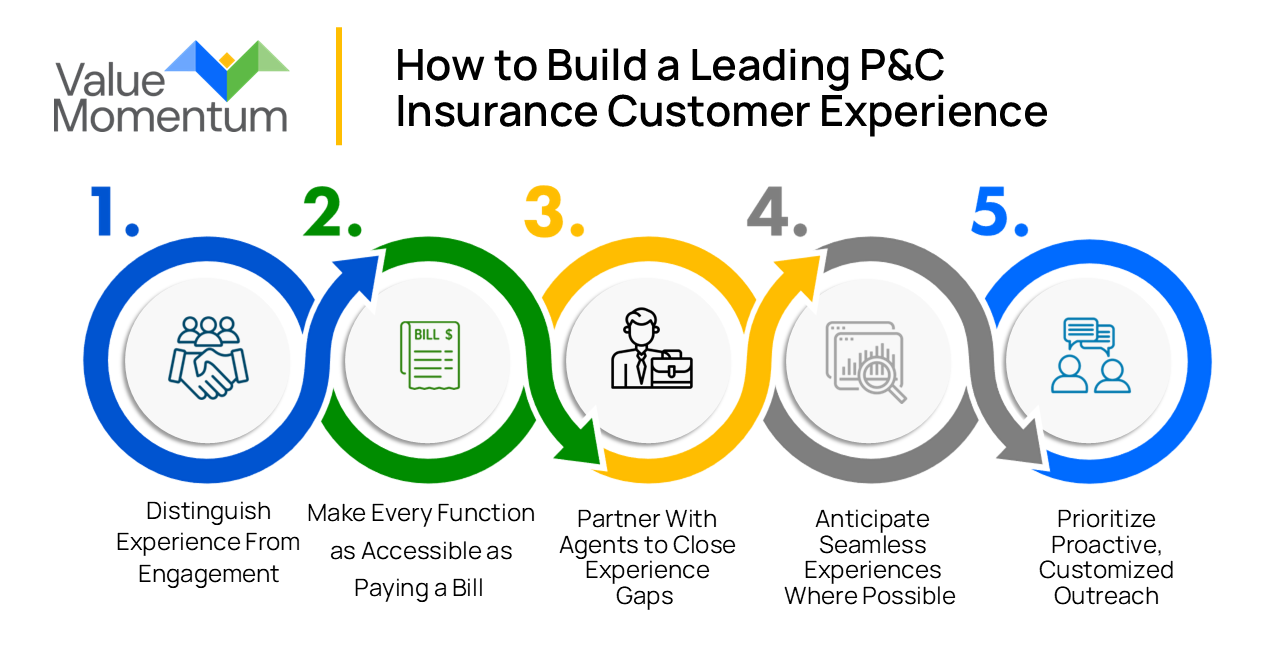
1. Distinguish Experience From Engagement
Engagement and experience often get treated as the same thing. Engagement is the channel: a portal, a website, a customer service representative (CSR), or an interactive voice response (IVR) system. Experience is how seamlessly each of those channels works. A carrier can keep adding channels and still deliver a poor experience if each one operates on its own.
The goal is an experience that holds up everywhere, not one standout channel. Experience covers look and feel, ease of use, and intuitive functionality in every transaction, from shopping for a policy to filing a claim. It also includes relevant cross-sell and upsell recommendations timed to major life changes, such as buying a home, getting married, having a child, or adding a teen driver.
2. Make Every Function as Accessible as Paying a Bill
Most carriers have made one task effortless. A policyholder who calls to pay a bill can usually get through right away. Almost any other request means supplying extensive information just to get routed to the right place. That raises an obvious question: Why isn’t every function that easy to reach?
Phone-based service is also the most expensive to run. CSR and IVR interactions mean wait times for policyholders and staff time for carriers. Web remains the primary self-service channel, with mobile close behind, and mobile will become more powerful as insurers integrate AI into their apps. Bringing the directness of bill pay to policy changes, claim status, and coverage questions reduces friction for policyholders and cost for carriers at the same time.
3. Partner With Agents to Close Experience Gaps
Agents see gaps in the experience that carriers often miss because they work with policyholders every day and hear firsthand where the process breaks down. When carriers treat agents as partners in shaping new tools, those gaps surface early. Yet few carriers invest the time to build that partnership at the technology level.
A carrier can’t simply move ahead on its own. It has to bring agents along or risk losing business. One approach is an agent technology task force. One insurer worked with a subset of its agents over several years to encourage adoption, then rotated in a new group. Each rotation widened the circle of agents helping to shape the tools they use every day.
4. Anticipate Seamless Experiences Where Possible
There are many opportunities across the insurance life cycle where insurers could remove friction from the customer experience. For example, why should a personal auto policyholder still fill out a first notice of loss (FNOL) form after an accident? Extending automatic loss reporting features already present in fleet programs could greatly simplify personal auto FNOL. The same logic applies in homes or small businesses with smart fire and water sensors and security systems that can detect a loss the moment it happens.
Similar opportunities exist across other lines of business. Travel insurers might consider proactive payment upon a flight delay or a trip cancellation. Sophisticated policies should anticipate policyholders’ needs based on the terms of the coverage, providing keyless FNOL wherever possible. These opportunities will only continue to grow as technology evolves. Forward-looking insurers will stay ahead of the competition by monitoring for gaps where friction can be removed.
5. Prioritize Proactive, Customized Outreach
Better access doesn’t help if policyholders don’t know what’s available or where to find it. Carriers can’t expect customers to seek out information on their own. A VIU by HUB survey conducted by The Harris Poll found that 88% of policyholders would value a provider that alerts them when their coverage no longer fits. Yet 56% said their provider has not proactively contacted them in more than a year, or they aren’t sure it ever has.
Proactive outreach, delivered through each policyholder’s stated channel preferences, closes that gap. Customer communications management (CCM) platforms help carriers keep renewal notices, billing reminders, claim updates, and coverage recommendations consistent across every channel. Communication is often the last piece carriers modernize, yet it’s the one policyholders notice first, and their expectations for it are only growing.
Policyholders have no shortage of options when it comes time to choose an insurer. Providing a leading CX can make the difference between building long-term customer relationships or facing heavy customer churn. Attracting new customers is only a growth strategy if a carrier plans on retaining most of them, and CX plays a major role in keeping policyholders happy with not just their coverage terms but with their relationship with the overall organization.
Building a CX that can achieve all of these goals and drive the business forward requires constantly looking ahead and adapting the experience roadmap based on new features and value-adds for both existing and prospective customers.
The Next Standard for P&C Insurance Customer Experience
The bar for P&C insurance customer experience will keep rising. Connected devices will increasingly flag a loss before the policyholder picks up the phone, and AI will make mobile the first place customers turn, whether they have a coverage question or need an update on the status of their claim.
Carriers that build for that future now, with agents alongside them, will set the standard competitors have to meet. Policyholders won’t compare their insurer to other insurers. They’ll compare it to everything else on their phone.
Want to learn more about modernizing digital engagement for agents and policyholders? Watch our on-demand webinar, “Modernizing Digital Engagement With Guidewire JDP.”