

P&C carriers are finding it harder to keep customers. Even as customer satisfaction has held steady, 29% of insurance customers switched their insurer in 2025, according to J.D. Power’s 2026 Insurance Intelligence Report. When price stops being enough to hold a policyholder, the experience of doing business with a carrier matters much more. Customer experience (CX) now drives whether insurers keep existing customers, attract new ones, and grow profitably.
Insurers of every size sit at different stages of CX maturity, and many aren’t sure which areas to invest in next. Part of the challenge is knowing what good looks like. Claims surveys flag problems quickly, but friction in quoting, billing, and servicing often goes unnoticed, causing leakage carriers can’t trace.
For carriers weighing their next technology decision, putting CX dollars where they actually move retention and growth is the difference between an experience that keeps policyholders and one more portal nobody uses.
How to Improve Customer Experience in P&C Insurance
In its 2026 U.S. Insurance Digital Experience Study, J.D. Power found that nearly half (47%) of new auto and home policies are now purchased digitally. Satisfaction with the digital shopping experience fell 12 points year over year. More buying is moving to digital channels just as satisfaction with them drops.
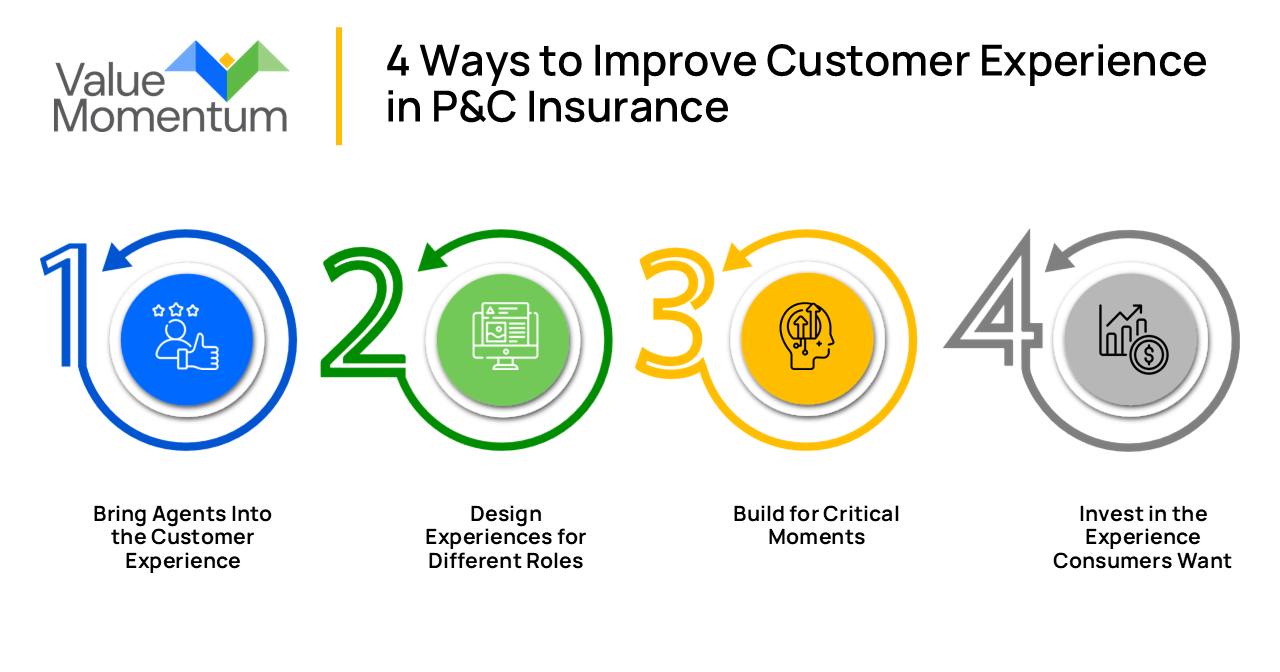
A good CX in P&C insurance comes down to two measures: how quickly a user reaches their goal and how much they trust the result. That goal might be getting a quote, pulling up an ID card, or receiving an update on a claim. The four approaches below help carriers improve on both primary CX measures, no matter the goal in question.
1. Bring Agents Into the Customer Experience
In pure retail, improving CX means focusing on the customer. P&C insurance is different. Apart from direct writers, most carriers reach customers through agents, so CX can’t be designed around the policyholder alone. The agent’s experience directly shapes how customers experience a carrier’s products and services.
That relationship needs careful handling. Agents can feel crowded out or displaced when carriers roll out new digital capabilities. At the same time, agencies typically don’t invest in technology the way carriers do, which can slow adoption of better experiences across the whole value chain. A carrier can’t simply move ahead on its own. It has to bring its agents along or risk losing business.
2. Design Experiences for Different Roles
Agents and customers may complete the same transaction, but they need very different things on screen. The biggest difference is how often each persona uses the system. A customer might request a quote once or twice a year at most. An agent runs quotes five days a week.
For customers, the better experience spreads less information across more screens. Each step is easy to process and absorb before moving on. Because customers interact with their insurer so rarely, look and feel matter less than ease of use and intuitiveness. The experience should create as little cognitive load as possible. This is also why general experience design skills don’t automatically translate to insurance. A design pattern that works for a daily-use shopping app may overwhelm someone who files an insurance transaction once a year.
Agents need the opposite: denser screens and fewer of them, so they can work through a familiar process quickly. The design choices differ, but the goal is the same for both roles, which is efficiency and effectiveness.
3. Build for Critical Moments
Claims is the heartbeat of insurance. It’s the reason customers buy a policy and the service they hope never to use. When a customer does need to file a claim, the experience has to deliver. Designing first notice of loss (FNOL) well starts with the customer’s state of mind. Someone who has just been in a car accident is likely shaken and distracted, so FNOL should ask only for essential information and take a click or two, not require someone to fill out a long form.
Agents need something different at that same moment. They want as much detail as possible because their guidance might be to not file a claim at all. The best claims experiences capture whatever the customer can share digitally and route it to the agent, who can follow up the next day. Designing that process means understanding today’s workflow well enough to orchestrate a better one that includes the agent.
4. Invest in the Experience Consumers Want
Digital preference will only continue to grow as Millennials and Gen Z become a larger share of the consumer base, and these customers are quick to leave when digital channels disappoint. An Insurity survey found that 28% of Gen Z and 21% of Millennials report having switched insurers due to a frustrating online or mobile experience.
Web remains the primary channel for most carriers, and mobile is becoming more capable as insurers integrate AI into their apps. That makes websites and mobile apps a central part of the customer experience rather than a supplement to it. For younger policyholders especially, a clunky portal or app can decide whether they renew or switch.
Making changes in these four areas helps insurers put every customer touchpoint to work, creating an experience for both policyholders and agents that matches other industries and keeps the business growing.
The Future of Insurance CX
Expectations for CX in P&C insurance will keep rising as digital channels grow more capable and younger policyholders make up more of the market. Carriers that keep pace will treat CX as more than a digital front end. They will design for customers and agents, anticipate what policyholders need in the moments that matter most, and meet them in the channels they prefer.
Price may win the first policy, but experience wins the renewal.
Want to learn how insurers are building better digital experiences for agents and policyholders? Download the white paper, “Unlocking Better Digital Experiences With Jutro Digital Platform