

Traditionally, insurance career pathways began with roles such as underwriting assistants, junior adjusters, and entry-level analysts, which served as informal apprenticeships. Employees built judgment over time by repeating tasks and being exposed to real-world situations. The cyclical nature of these experiences wasn’t inefficient; it was a training ground.
But the way employees build up their knowledge is changing, and not just in insurance. Nearly 39 % of core skills required on the job are expected to change by 2030 as technology reshapes work, and 63 % of employers cite skills gaps as the biggest barrier to transformation. The rise of autonomous systems and agentic artificial intelligence (AI) is altering how tasks are done. McKinsey estimates that while many skills remain applicable, AI will increasingly perform routine and context-specific work, shifting human effort toward interpretation and decision-making.
Without intentional focus on the preservation of learning pathways, the insurance industry risks a future where throughput grows but judgment thins, leaving tomorrow’s experts without the tacit knowledge once acquired through on-the-job experience.
Agentic AI Erodes Informal Apprenticeship
The shift toward agentic AI in P&C insurance is rooted in the reorganization of work itself. Across underwriting, claims, and IT, insurers face mounting pressure to move faster, enhance operational efficiency, and scale output without expanding already-constrained talent pools. Modernization initiatives are pushing automation deeper into core workflows to reduce fragmentation and manual effort.
Agentic systems can accelerate intake and triage; reduce manual handling; and deliver earlier, more consistent decisions to the problems insurers confront every day. By moving automation earlier into the workflow, these tools absorb tasks that once required hands-on human review and coordination, easing front-end bottlenecks and improving throughput without adding headcount.
However, these early gains are only part of the story. As these systems assume responsibility for early interpretive work, human involvement shifts later in the process, often toward validation or exception handling. The exposure that once came from handling volume, seeing variation, and developing judgment through repetition becomes less common.
When systems take over the work that teaches people how to think, learning slows even as throughput increases. Automation is not replacing expertise outright, but it is replacing the work that produced expertise in the first place. The question now facing insurers is how to preserve the development of judgment and expertise without sacrificing technological advancement.
Turn Automation Into a Learning Advantage
To harness the true competitive edge that agentic AI can offer, insurance leaders must shift from seeing automation solely as a speed and cost play to viewing it as a learning companion.
With a few simple measures, insurers can use agentic AI to preserve and even accelerate the cultivation of expertise.
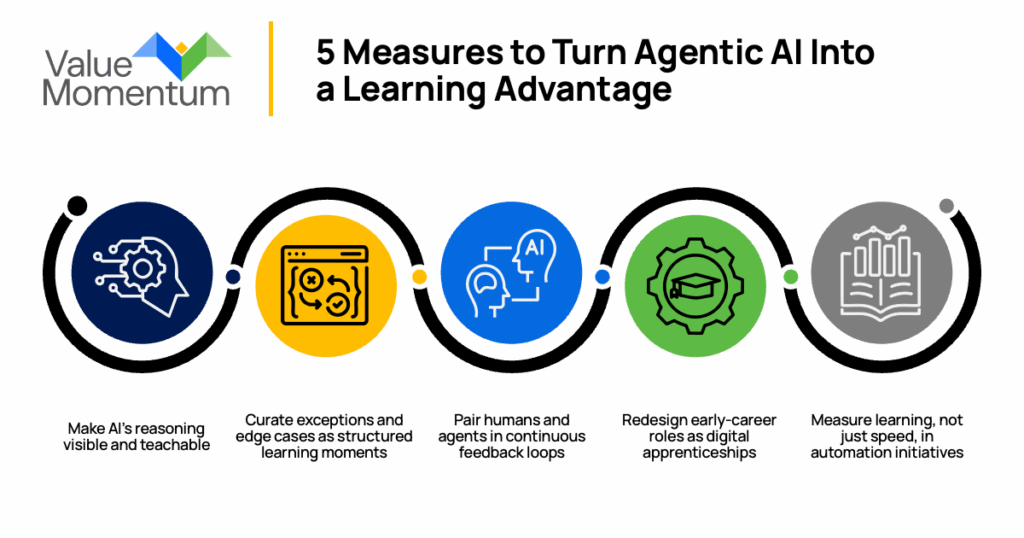
1. Make AI’s reasoning visible and teachable.
AI isn’t inherently self-explanatory. When systems surface their logic — such as the data they used, what was missing, and why they routed or flagged a case — employees learn how decisions unfold, not just what the outcome was. This transforms “approval” work into active learning instead of passive oversight.
With more than 70% of today’s skills adaptable to new work contexts but requiring human interpretation and judgment, agents and underwriters can build deeper expertise by reviewing and questioning AI reasoning, rather than simply accepting outputs.
2. Curate exceptions and edge cases as structured learning moments.
When AI handles the routine, the exceptions become the most instructive parts of work. Instead of thinking of exceptions as “problems to fix,” treat them as opportunities to train human judgment. Employees can examine why a system hesitated, what inputs mattered most, and how context should influence interpretation. This helps preserve skill formation through variation and reflection — the same mechanisms traditional apprenticeships relied on.
Industry observers warn that AI’s rapid automation can lead to deskilling when humans are removed from the interpretive loop, underscoring the value of structured human engagement with edge cases.
3. Pair humans and agents in continuous feedback loops.
Human–AI interaction should be cyclical, not sequential. When employees correct, refine, or challenge an agent’s output, that feedback should feed back into improved models and workflows. This shifts the dynamic from “AI does, humans check” to “humans guide, AI learns.” Over time, such loops help both machines and people learn more deeply and more quickly.
Carriers that design AI systems with this intentional human feedback vector can capture institutional judgment and help newer staff internalize reasoning patterns that used to only come from experience.
4. Redesign early-career roles as digital apprenticeships.
Rather than eliminate roles that are “low value,” insurers should redefine entry-level work around learning work — i.e., tasks that expose new hires to reasoning, judgment, and context.
When early-career professionals are tasked with auditing AI summaries, validating triage decisions, or explaining why an agent’s output makes sense, they gain dual fluency: domain expertise and AI literacy. This helps ensure that tomorrow’s leaders are not only comfortable with AI but have deep insight into the logic behind decisions.
5. Measure learning, not just speed, in automation initiatives.
Traditional automation success metrics like cycle times, throughput, and cost per case don’t capture whether expertise is growing or shrinking. Insurers should introduce KPIs that reflect judgment development, such as:
- Reduction in manual override rates over time
- Quality of human-generated explanations of edge cases
- Increase in confidence and decision quality in manual reviews
Tracking these outcomes ensures that automation strengthens human capability rather than eroding it.
When designed with learning in mind, agentic AI can become a catalyst for developing expertise rather than a force that diminishes it.
Preserving Expertise in an AI-Driven Future
Agentic AI’s ability to accelerate decisions and absorb foundational tasks offers undeniable operational value to insurers. But left unchecked, those same efficiencies can weaken the informal apprenticeship model that has long produced sound judgment, deep expertise, and institutional resilience.
The insurers that succeed in this next phase of transformation will be those that design AI adoption with learning in mind. By making reasoning visible, preserving opportunities for contextual judgment, and redefining early-career roles around interpretation and oversight, carriers can ensure automation strengthens human capability rather than diminishing it.
To continue to explore the career development opportunity presented by agentic AI, read my e-book “The Vanishing Apprenticeship: Rebuilding Career Pathways in the Age of Agentic AI.”