



Agility, predictive intelligence, and operational resilience have become paramount for success in property and casualty (P&C) insurance, and achieving these capabilities requires a continuously evolving core platform. Since its initial launch, Guidewire Cloud Platform (GWCP) has matured from a cloud-hosted infrastructure model into a fully cloud-first, microservices-driven ecosystem.
A key driver of this evolution remains Guidewire’s strategic commitment to three cloud releases per year. This rapid, predictable release cadence ensures that IT and business teams have immediate, continuous access to cloud updates, completely eliminating the friction of traditional multi-year upgrade cycles.
As carriers evaluate their modernization roadmaps, here are answers to some of the top questions our team is asked by Guidewire InsuranceSuite customers who are in the process of or are considering moving to GWCP.
Q1: What is Guidewire Cloud Platform?
GWCP is a fully managed, cloud-first Software-as-a-Service (SaaS) ecosystem built specifically for the P&C insurance industry. Unlike traditional on-premises deployments or simple lift-and-shift cloud hosting, GWCP leverages a modern microservices architecture optimized on Amazon Web Services (AWS). GWCP decouples core insurance applications (Guidewire PolicyCenter, BillingCenter, and ClaimCenter) from external integrations and peripheral services. Today, the platform embeds advanced AI tools, intelligent task orchestration frameworks, and robust data streaming pipelines directly into the core environment.
Q2: What are the primary business and technical advantages of GWCP?
Transitioning to GWCP shifts the conversation from maintaining infrastructure to driving business differentiation. A couple of the key advantages include:
- Continuous innovation with low overhead: Guidewire delivers three updates annually for InsuranceSuite by separating applications into a customer-modifiable layer and a Guidewire layer that is replaced each release. To ensure streamlined adoption, Guidewire prevents breaking changes by providing forward-compatible APIs and pre-validates each release against existing cloud configurations. Customers can adopt updates directly into their implementation branches and choose how, when, and which new features to implement using update instructions from Guidewire.
- Embedded AI and predictive analytics: Carriers can immediately inject real-time machine learning and behavioral data into their core processes via native integration with tools like Guidewire Predict, HazardHub, and ProNavigator, optimizing risk selection and automated claims triage.
- Decoupled integration architecture: By utilizing standard microservices layers and event-based notifications rather than embedding complex point-to-point logic directly inside InsuranceSuite, downstream and external systems remain insulated from core system upgrades.
Q3: What are the phases of a modern GWCP implementation?
As with any cloud implementation, timelines are determined by the specific requirements of each engagement.
A typical Guidewire Cloud implementation can be broken down into five phases: Readiness, Transition, Development, Stabilization, and Deployment and Warranty. This phased approach is intended to help customers meet their strategic goals and maximize their cloud investments.
The breakout of the phases is below:
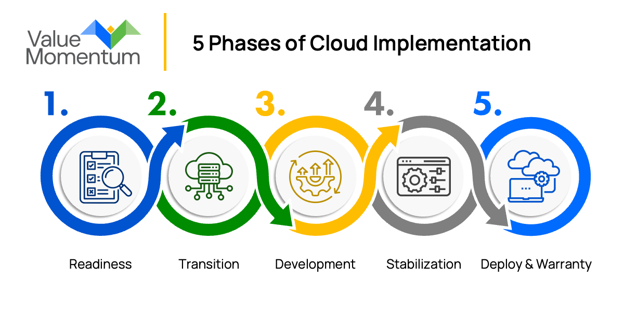
The Readiness stage begins with a pre-work assessment to examine the current technology setup and the best course of action for the insurer. Guidewire uses its Vantage methodology to guide customers through the implementation process. It will conduct a cloud workshop evaluation, providing an indicative Cloud Upgrade Estimate (CUE), a proposed timeline, and a suggested release plan. We also recommend reviewing the technical findings from a cloud optimization backlog. Completing the Readiness stage can take a typical insurer anywhere from 1-4 weeks depending on the size of the organization.
The Transition stage starts with technical upgrades and the initial code merge. Once that has begun, it is time for the infrastructure setup on Guidewire Cloud. In addition, during the Transition phase, Guidewire defines a program roadmap and develops a cloud deployment strategy based on the carrier’s needs. It is also beneficial to define a list of key functions and workflows, create a conceptual sprint plan, and propose a testing strategy. Completing all the components of this phase can take, on average, anywhere from 3-4 weeks.
The Development stage includes many steps: cloud optimization and remediation, refactoring development requirements when necessary; upgrade validation; test plan development and execution; and validation and demonstration of key workflows. An early systems integration test may be performed where appropriate. In most cases, this stage can take anywhere from 2-4 months.
The Stabilization stage is where end-to-end system integration testing (SIT) and support user acceptance testing (UAT) are performed. This is the part of the process where the deployment plan is finalized, users get trained on the system, and there may be an upgrade dry run. This stage usually lasts 2-4 months.
The Deployment and Warranty stage is where, of course, deployment is executed. On top of that, a post-production support plan is created along with a cloud data access strategy. Warranty support is also provided. This usually lasts one week to a month.
Q4: How do I maximize the value of my investment in GWCP?
Maximizing ROI starts with accurate visibility into what the migration requires, not just architectural best practices. Before committing to a migration path, insurers should engage Guidewire and a Consulting partner to complete a CUE. The CUE delivers a: program timeline; recommended migration path and release plan, effort broken out by delivery area (technical upgrade, database upgrade, post-upgrade delivery, and testing); and documented scope and set of assumptions. That data turns “invest in the right architecture” from a generic recommendation into a funded, sequenced plan.
Once that plan is in place, the highest-leverage investment is a “clean” core by reducing custom code and externalizing business logic so applications absorb the three annual updates from Guidewire without breaking downstream systems. Guidewire has built multiple features that make this practical: the Apache Camel-based Guidewire Integration Gateway and Kafka-based AppEvents provide a centralized microservices layer that decouples core systems from third-party APIs; Advanced Product Designer (APD) accelerates speed to market by generating cloud-compliant configuration and API endpoints; and Guidewire Predict, HazardHub, and Claims Assistant embed predictive analytics directly into underwriting and claims workflows. Autopilot Workflow Service drives straight-through processing (STP) and Jutro Digital Platform standardizes the digital experience across policyholders, agents, and employees.
The other lever insurers often underuse is the delivery model. Programs run under Guidewire’s Lighthouse model, an enhanced technical upgrade approach, which pre-validates the codebase, resolves Cloud Assurance violations, and confirms core workflows before the formal delivery team ever engages. The goal isn’t just to preserve the existing investment, but to protect it while modernizing it to current cloud standards, so insurers are upgrading its footing along the way. That means the delivery phase starts from a production-ready, modernized foundation instead of an unknown one, which protects the investment already made in the technical upgrade and reduces costly rework downstream. Combined with automated CI/CD pipelines and native Blue/Green deployment for zero-downtime releases, this separates insurers who get compounding value from GWCP from those who just maintain it.
Q5: How can I ensure a smooth transition to GWCP?
The single most important step toward a smooth transition is starting with an accurate picture of what the migration involves. Engaging Guidewire and a Consulting partner to complete a CUE and Cloud Readiness Workshop early, well before a formal delivery timeline is set. These surface the technical scope, integration complexity, and data considerations that would otherwise be discovered mid-project. The process itself is straightforward: the insurer completes a detailed questionnaire, runs the required database health reports, and packages application configurations for submission through Guidewire’s community portal. In return, Guidewire produces a CUE report with an indicative estimate and cloud optimization backlog, giving the organization a clear, documented view of what needs to happen before upgrade work begins.
The second lever is choosing the right delivery model. Guidewire’s Lighthouse program, an enhanced technical upgrade approach, pre-works the migration ahead of formal delivery. It resolves merge conflicts, remediates Cloud Assurance findings, and validates core workflows through Integration Gateway simulation. Rather than handing the delivery team a partially merged codebase and unresolved risk, Lighthouse produces a validated, delivery-ready foundation with a prioritized backlog and full knowledge transfer package. Just as importantly, Lighthouse preserves what the insurer already has and modernizes the codebase to current cloud standards in the process, so the investment being protected is upgraded and not just carried forward as-is. Insurers who select this model consistently see shorter, lower-risk delivery phases because the delivery team validates a modernized, known-good foundation rather than discovering problems in a legacy one.
Finally, ongoing alignment with Guidewire’s product direction matters. Keeping customizations close to out-of-the-box functionality and following Vantage guidelines for new interfaces reduces the effort required for each of the three annual releases. This is a maintenance discipline that follows a strong CUE and delivery model choice; it isn’t a substitute for getting those two decisions right up front.
Q6: How can I gauge my organization’s level of readiness for GWCP?
Gauging readiness requires a multi-dimensional assessment spanning an insurer’s technical architecture, operational culture, and business strategy. Organizations should evaluate their readiness against four primary pillars:
- Technical code compliance: The volume of custom Gosu code, modified database schemas, and deprecated APIs currently within the on-premises codebase
- Integration complexity: The presence of tightly coupled, point-to-point legacy integrations that must be refactored into modern, API-driven architectures
- Data maturity: The ability to decouple historical operational reporting from core application engines, transitioning instead to automated cloud data streaming solutions
- Operational agility: The willingness of internal IT and business groups to adopt a continuous, agile release cadence rather than traditional multi-year upgrade project frameworks
For insurers considering upgrading to GWCP, engaging with Guidewire and a system integrator (SI) partner to perform a CUE and Cloud Readiness Workshop will give an idea of the organization’s level of readiness. This assessment will look at an insurer’s needs for configuration and integration. As part of the assessment, Guidewire will publish a “mandatory terms” list covering the readiness activities prior to initiating upgrade. The transition assessment and the mandatory terms will provide a clear view of what is needed to prepare the organization for an upgrade to GWCP .
Other components of this assessment include a CUE report, which will provide an indicative estimate for technical upgrade and a list of cloud optimization backlog items that must be addressed. A trusted consulting partner can help insurers fully understand all these findings before starting any cloud implementation work. At ValueMomentum, for example, we provide a pre-cloud remediation process that allows insurers to feel confident that their implementation approach is customized for their organization’s needs and will resolve hidden technical debt before the formal cloud transition begins.
Q7: How is security handled on GWCP?
Security on GWCP has evolved from a basic discussion around infrastructure ownership into a rigorous, Zero-Trust-compliant ecosystem. Under Guidewire’s shared security model, infrastructure and application security are managed continuously at scale. Security is implemented through a shared responsibility model where Guidewire secures the underlying cloud platform while customers are responsible for the security of their data, configurations, and access controls.
Guidewire leverages the latest authentication and access control measures, including mandated modern identity management using OAuth 2.0, enabling secure, token-based authentication and seamless single sign-on (SSO) integration with enterprise Identity Providers (IdPs).
On top of these built-in processes, engineering teams must prioritize embedding secure coding, SAST, and DevSecOps controls within their CI/CD pipelines. All these measures and protocols ensure that security is a foundational capability built directly into engineering workflows.
Embracing the Future of Insurance Technology
A GWCP migration goes beyond technical upgrades. Insurers investing in making the most out of their cloud-first core systems can fully transform their business operations if they maximize their investments.
By embracing a clean core, automating (where possible) and standardizing on Cloud Integration Framework, embedding AI capabilities, and organizing around the modern release cadence, carriers can position themselves to actively lead the P&C market instead of reacting to industry shifts. With the right preparation, automated tooling, and strategic delivery partners, the transition to GWCP can help carriers establish an enduring foundation for continuous, high-performance innovation.
To learn more about how insurers are driving value with ValueMomentum’s Guidewire services, visit our Guidewire partner page.