


Claims functions across the UK face a relentless combination of pressures: claims indemnity is increasing due to increase in severity as well as inflation, loss adjustment expenses that erode margins, handlers stretched thin across growing caseloads and reserve accuracy challenged by inflationary volatility. Advanced analytics is already helping claims leaders address these challenges earlier and faster.
For instance, they are helping insurers identify high-severity cases earlier, detect fraud at intake, assess litigation propensity and surface subrogation opportunities that would otherwise go unrealised. The difference between insurers who do this well and those who stall is rarely the models in use. Instead, it is typically an well designed architecture problem.
Many insurers are turning to Amazon Web Services (AWS) to build the analytical infrastructure needed to drive critical claims outcomes, given the cloud giant’s broad functionality, scalable architecture and ease of integration with core claims platforms like Guidewire, Duck Creek and Sapiens.
5 steps to a scalable AWS architecture for claims analytics
When it comes to claims decisions, structured data is only part of the picture. Policy records, prior payouts and settlement timelines are relevant, but other critical signals are buried in handler notes, first notice of loss (FNOL) call recordings, repair estimates and medical reports.
A modern claims analytics architecture has to be prepared for all types of inputs. While insurers have no shortage of tools to choose from for creating analytical models and analysing data, AWS provides an expansive (and scalable) suite of machine learning and data services that can readily integrate with the core claims platforms insurers use most often. Using claims severity detection as a use case, here is a step-by-step walkthrough of how to build the AWS architecture needed for an analytics-driven claims function:
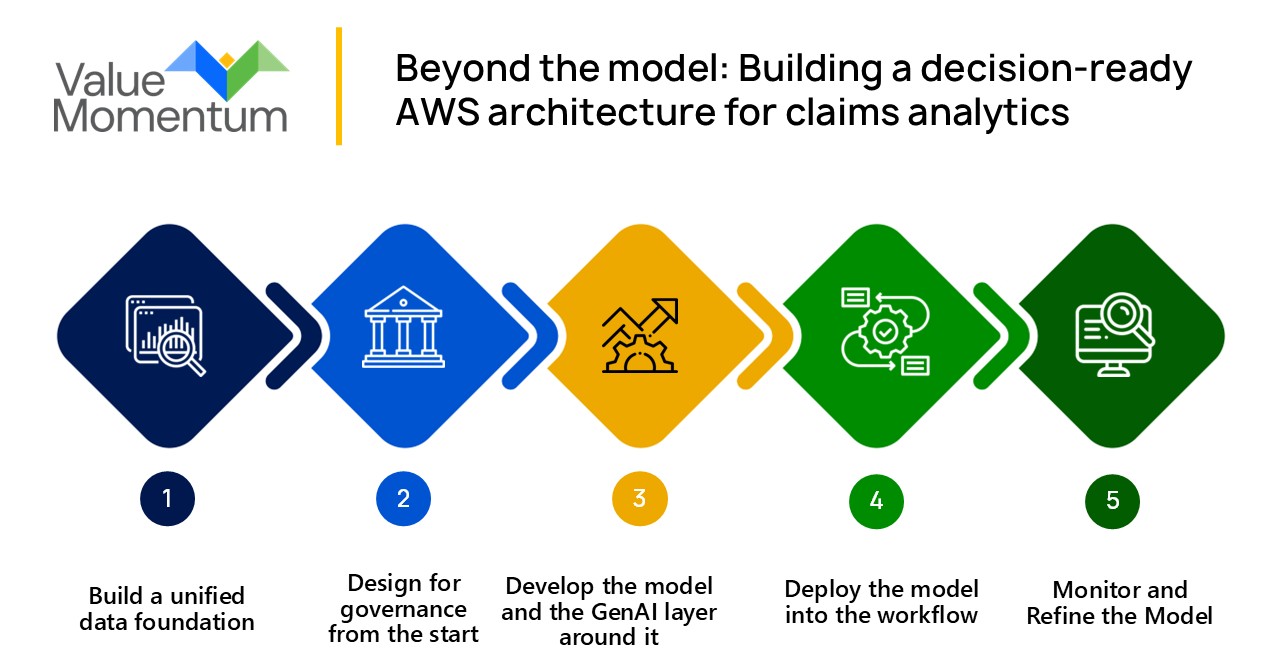
1. Build a unified data foundation
Every effective analytics programme begins with data that is harmonised, queryable and trustworthy. For a severity model, that means consolidating policy data, historical claims, handler notes and adjuster observations into a consistent format.
On AWS, AWS Glue hands the extract, transform and load (ETL) work, then catalogues the data. Amazon S3 anchors the data lake, and AWS Lake Formation applies fine-grained, column-level access controls over the data. This increasingly sits within Amazon SageMaker Lakehouse, which unifies S3 and Amazon Redshift behind a single governed catalogue.
Curated model features are managed in Amazon SageMaker Feature Store, with an online store for low-latency scoring at first notification and an offline store for training. This ensures the same fraud or severity features can be reused across multiple models instead of needing to be re-built each time.
The unstructured layer is where the tools used may differ by use case. Amazon Textract extracts data from repair invoices, loss runs and medical reports. Amazon Comprehend pulls entities and sentiment from free text, while Comprehend Medical does the same for bodily injury claims. For real-time intake, Amazon Kinesis streams events from the core claims platform to flag high-severity cases as they arrive.
2. Design for governance from the start
Data governance must be designed into the architecture from the outset, not bolted on after models are deployed. For UK claims organisations, being able to show that claimant data is secured and that decisions are auditable matters just as much as predictive accuracy.
AWS Identity and Access Management (IAM), Key Management Service (KMS) and Amazon Macie secure and continuously scan for sensitive claimant data, and Lake Formation governs who can see which fields. Selecting the London Region (eu-west-2) to keep the claimant data in the UK.
For defensibility, Amazon SageMaker Model Cards document each model’s intended use and limitations, the Model Registry tracks versioned lineage and AWS CloudTrail provides an immutable audit trail. Amazon SageMaker Clarify measures bias before and after training as well as produces feature-level explanations to ensure that handlers and regulators can easily understand scoring.
Building these controls in early means that uses cases like fraud detection and litigation propensity inherit the same guardrails without rework.
3. Develop the model and the GenAI layer around it
With data and governance in place, the next step is building the model itself. This happens in Amazon SageMaker AI, the newly renamed build-train-deploy service accessible within the SageMaker Unified Studio environment. Here, data scientists run experiments across configurations, with fully managed MLflow tracking each run as a native capability.
Amazon SageMaker Pipelines then orchestrates the production MLOps workflow, spanning from preprocessing incoming data and running drift checks against a baseline to training, evaluating and registering updated model versions. This workflow ensures that only the best-performing model advances. Automatic retraining keeps the severity model current as repair costs, litigation trends and claimant behaviours shift.
The decisive addition for claims organisations is the generative layer. Amazon Bedrock powers handler copilots that summarise FNOL, draft triage rationales in plain language and surface next-best-action recommendations. Insurers can ground these outputs in their own policy wordings and handling manuals using Bedrock Knowledge Bases (rooted in retrieval-augmented generation). Bedrock Guardrails enforce personally identifiable information redaction and prevent ungrounded responses.
4. Deploy the model into the workflow
Models only create value when handlers act on them. AWS EventBridge triggers deployment when a new version is approved or an existing one drifts below the threshold. All insurers should have a mandatory human sign-off built in before anything reaches production. Infrastructure is provisioned consistently across development, testing and production environments with Terraform. Amazon API Gateway integrates the model with the organisation’s core claims platform.
Match the inference pattern to the decision: real-time endpoints for scoring at first notification, batch transform for overnight reserving runs, serverless inference for spiky volumes and asynchronous inference for large document workloads.
Rather than making a hard switch, SageMaker shadow testing runs a challenger model against live FNOL traffic without affecting decisions. Because no model should make finely balanced calls unsupervised, Amazon Augmented AI (A2I) routes low-confidence predictions to handlers for review.
5. Monitor and Refine the Model
Deployment is the beginning of the cycle, not the end. Claims data shifts constantly, due to litigation behaviour, repair cost inflation and evolving fraud patterns. Even a model that performs well at launch will quietly decay if left alone.
AWS SageMaker Model Monitor racks data quality, model quality, bias drift and feature attribution drift. Clarify continuously watches for fairness, while Amazon CloudWatch with Amazon SNS alerts the data science team when performance moves outside acceptable parameters. A SageMaker Model Dashboard provides claims leaders with a single view across their entire model fleet.
When issues are detected or thresholds are breached, retraining pipelines are triggered automatically. These automatic pipelines keep the severity model and any others built on the same infrastructure aligned with the current claims environment.
This architecture is not limited to claims severity. It can be extended across use cases such as fraud detection, litigation propensity, subrogation recovery and reserving, providing a scalable foundation for analytics-driven decision-making across the full claims life cycle.
Smarter claims organisations start with the right architecture
For UK insurers navigating soaring loss adjustment expenses, complex reserving accuracy and heavy handler caseloads, the ability to embed advanced analytics directly into the claims workflow turns reactive claims handling and proactive loss management.
When executed well, this AWS architecture helps claims leaders deliver on the business outcomes they are measured by and helps handlers deliver defensible, consistent decisions on every claim.
But infrastructure is not enough. The strongest returns come from pairing the right architecture with deep insurance domain expertise, guaranteeing that models are trained on meaningful data, governed responsibly and integrated into the workflows where handlers actually make decisions.
Interested in learning more about what AWS can do? Read our case study “Specialty Carrier Reduces LAE With Intelligent Document Processing”.