



May 22, 2026

6 MINUTES Read

AI for fraud detection: 5 best practices for UK claims organisations

AI for fraud detection 5 best practices for UK claims organisations

Share this post

Subscribe to our newsletter

Insurance fraud is nothing new, but its scale and sophistication have changed dramatically. Today’s schemes are organised, networked and increasingly tech-enabled. As Mark Allen, head of Fraud and Financial Crime at the Association of British Insurers (ABI), has warned, fraudsters are now deploying AI to make their operations harder to detect. The carriers pulling ahead are using the same technology to fight back.

UK insurers detected £1.16 billion in fraudulent general insurance claims in 2024, a 12% increase from the previous year. For individual carriers, the drag on loss ratios and combined ratios is material. Allianz UK alone detected 33,027 instances in 2024, equivalent to 90 fraudulent activities worth £430,000 a day, and 10% higher than the previous year’s figure.

This rise may largely be due to the increased organisation of gangs and bad actors through schemes like “crash-for-cash”, where organised gangs stage or induce collisions in urban centres, backed by professional networks producing false evidence. Then they file claims across multiple carriers simultaneously.

As Security Minister Tom Tugendhat has noted in Parliament, crash‑for‑cash fraud “has a direct implication for the pay packets and household economy of families across the United Kingdom”.

Fraud costs feed into premiums, and premium affordability is a cost-of-living issue.

Property lines tell their own story. The ABI recorded detected property fraud at £189 million in 2024, with exaggerated loss among the most prevalent types across the market. Allianz UK reported a 29% year-on-year rise in fake and exaggerated commercial theft claims, with voice analytics in personal lines surfacing opportunistic fraud that standard handling had not previously caught.

Volumes are rising and standard handling is not catching it early enough. Effective fraud detection at scale requires an integrated framework connecting data, analytics and decision-making from first contact, not applied retrospectively.

AI for fraud detection fills a critical gap

Standard claims handling is designed around process flow and customer experience. Unless a specific flag is triggered, claims move forward through assessment to liability investigation and toward settlement. By the time a referral happens, handling and legal costs have already accumulated.

Pick up a high-risk claim at intake and the cost profile might look completely different to the same claim surfaced three weeks later, when settlement pressure is building and the signals that should have prompted earlier action, prior claims history, referral patterns and incident location, have already been passed over. The financial outcome is largely set.

But static rule sets flag what they have already been told to look for. They miss emerging schemes, generate false positives on legitimate claims and operate in silos that cut off the external signals essential to accurate triage: Claims and Underwriting Exchange (CUE) data, geolocation, solicitor network patterns and credit information. This leaves special investigation unit (SIU) teams spending time on claims that should have been cleared, while genuinely fraudulent claims that fall outside existing patterns progress unchallenged.

Carriers deploying modern fraud detection infrastructure report shifts across several areas of claims performance. In the first half of 2025 alone, Aviva blocked more than 6,000 fraudulent claims and prevented over £60 million in losses, a figure that reflects investment in detection infrastructure rather than a spike in fraud volume. SIU productivity improves because automatic triage concentrates resources on genuinely high-risk cases, freeing teams from the low-value manual reviews that legacy rule sets generate in volume.

Low-risk claims move faster. Straight-through processing for claims that clear the detection threshold accelerates cycle times and reduces customer friction. False positive rates fall as models learn from patterns across structured and unstructured data. Fewer legitimate claims face unnecessary delay, cutting operational cost and friction simultaneously. Explainable scoring models provide a clear audit trail, giving carriers the transparency they need to demonstrate decision-making integrity to the FCA and other oversight bodies.

AI for fraud detection delivers

  • Fraud leakage reduces materially
  • SIU productivity improves
  • Low-risk claims move faster
  • False positive rates fall
  • Regulatory compliance is strengthened

The foundational elements of AI-driven fraud detection

Effective fraud detection at scale requires an integrated framework connecting data, analytics and decision-making into a coherent operating model, embedded in the claims process from first contact.
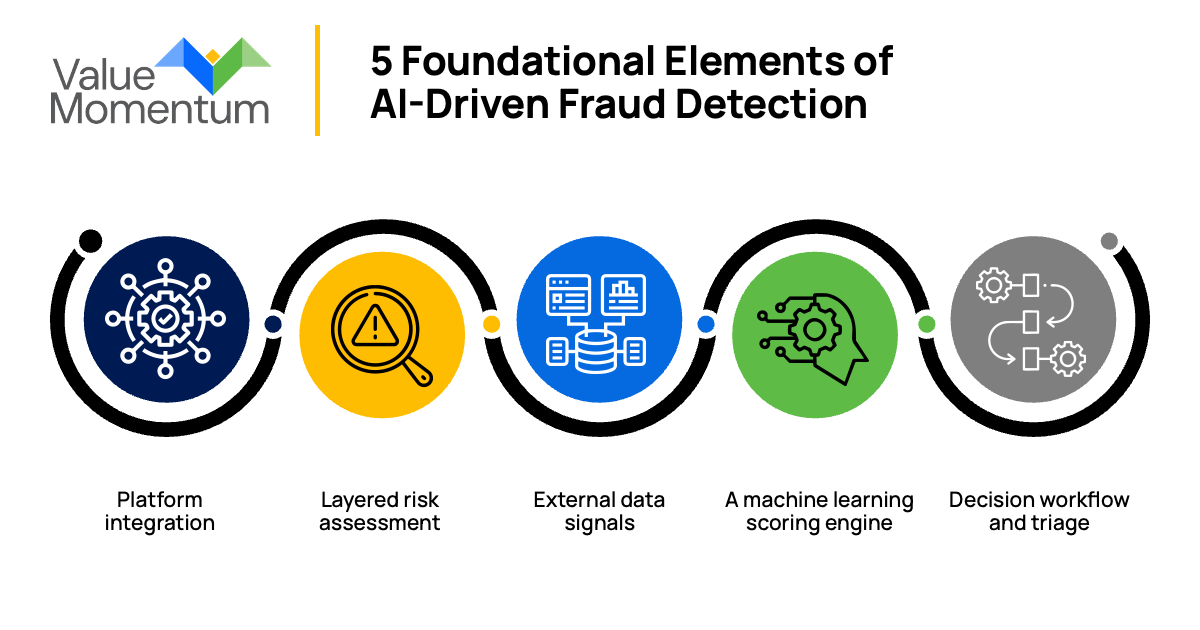
5 Foundational Elements of AI-Driven Fraud Detection

Platform integration

Detection capability must also extend beyond core claims systems into first notice of loss (FNOL) platforms, telematics feeds, repair networks, digital submission channels and contact centre operations. Leading UK carriers are increasingly embedding fraud screening directly into operational workflows to ensure suspicious activity is identified before downstream costs such as credit hire, repair escalation or litigation exposure begin to accumulate.

Layered risk assessment

Modern UK fraud operations are also incorporating behavioural and voice analytics to detect inconsistencies, coached responses and emerging fraud patterns that static rules engines typically miss. This is becoming increasingly important as organised fraud networks adopt more sophisticated and AI-enabled approaches to claims manipulation.

External data signals

In the UK market, cross-ecosystem intelligence is becoming a major differentiator. Leading insurers are combining CUE data, geospatial analysis, solicitor and medical provider patterns, device fingerprinting and graph analytics to identify organised fraud rings operating across multiple claims and carriers simultaneously.

A machine learning scoring engine

Advanced fraud scoring engines increasingly provide real-time decision orchestration rather than simple risk alerts. The output can dynamically trigger SIU referrals, enhanced investigations, payment controls or straight-through processing depending on risk severity, helping carriers balance fraud prevention with customer experience and operational efficiency.

Decision workflow and triage

The most effective operating models include continuous SIU feedback loops, allowing investigation outcomes to retrain models and improve scoring precision over time. This helps reduce false positives, improves SIU productivity and enables fraud strategies to adapt more quickly as fraud typologies evolve.

As Consumer Duty and FCA scrutiny continue to increase, explainability and governance are becoming as important as detection accuracy itself. UK insurers are therefore placing greater emphasis on transparent AI models, auditable decision trails and human oversight controls to ensure fraud prevention frameworks remain operationally effective while supporting fair customer outcomes.

The strategic case for advanced fraud detection

Catch more fraud earlier and the benefits follow. Loss ratios improve, combined ratios tighten, SIU capacity goes where it is needed and legitimate claimants move through faster resulting in better claims experience and outcomes. The leading carriers have analytics built in from FNOL, detection that learns continuously and triage driven by data rather than individual handler judgement.


Three questions for your next leadership review: 

  1. At what point in the claims life cycle is fraud risk currently assessed in your operation, and how much cost is already committed by that point?
  2. Are your fraud detection signals integrated and assessed at FNOL or evaluated sequentially and manually?
  3. What is the measurable cost difference in your operation between claims identified as fraudulent at intake versus claims escalated to SIU after standard handling has progressed?

To learn more about how insurers are driving tangible business benefits across their claims organisations with analytics, watch our on-demand webinar Ask the Experts: Boosting Claims Efficiency & Effectiveness through Intelligent Automation.


Related Articles