

Digital channels have become a baseline expectation for insurance carriers. As of 2026, 47% of all insurance policies are purchased on digital channels. This puts application development at the center of how insurers deliver value to policyholders, agents, partners, and employees alike. But insurers need to do more than just build customer and agent portals.
According to J.D. Power, 92% of customers who report a high satisfaction score with their insurer’s digital experiences say they will definitely use those channels again. When experiences fall short, that number drops to 40%. A modern user experience (UX) must support varying users across every process, from claims management and quoting to billing and underwriting. Not only that, but the UX must remain consistent and intuitive across the entire insurance value chain.
Meeting this need requires insurance IT teams to take a scalable approach to application development. Modern digital experience platforms (DXPs), generative AI (GenAI)–enabled development workflows, and bespoke solutions are reshaping how insurers scale their applications while delivering a consistent, high-quality UX.
The Growing Role of User Experience in Insurance Operations
Applications are no longer paper systems of record; they are the primary interface through which policyholders, agents, and employees engage with insurance products and services. A strong UX helps insurers simplify inherently complex workflows, guiding users with clarity and consistency.
Well-designed applications shorten training cycles, reduce reliance on manual workarounds, and limit downstream errors that increase servicing costs. Conversely, fragmented or inconsistent experiences often slow adoption and make it harder for insurers to introduce new capabilities or scale digital initiatives across lines of business.
3 Ways to Enhance Application Development for Better User Experiences
Aligning application development strategies with modern UX principles allows insurers to innovate faster while maintaining control, consistency, and long-term flexibility. The following three strategies can help insurers modernize their approach to application development and deliver a better UX for all stakeholders.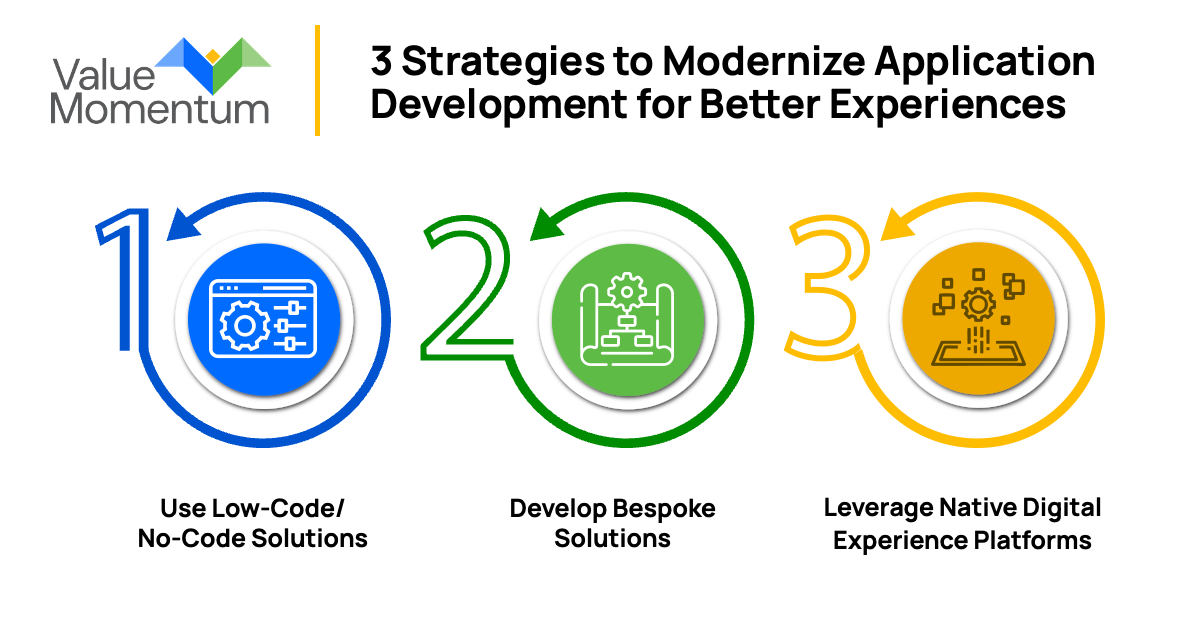
1. Use Low-Code/No-Code Solutions
Low-code/no-code platforms like Mendix enable insurers to rapidly develop common processes and accelerate their time to market. Instead of relying on traditional development practices, developers can configure applications or build new applications through graphical user interfaces (GUIs).
In practice, this means that insurers’ development teams can go from coding their engagement portals from the ground up to using drag-and-drop functionality or extending templates with some additional coding. While these platforms may limit UX customization, they can greatly accelerate the time it takes to build a new user portal or update an existing user interface (UI) to meet a new regulatory requirement.
Leveraging low-code/no-code platforms can also help insurers automate more of their process faster. Leading solutions typically have pre-built integrations to many core systems platforms, making this a simple process for insurers on commercial solutions.
Platforms like Mendix offer AI copilot capabilities that range from providing recommendations to generating new workflows, pages, or translations. Built-in AI copilots can help developers not only generate better results in the short term, but also enhance their ability to scale the low-code platform’s capabilities alongside business goals.
This may be the right approach for organizations with limited in-house developer skills or whose strategic goals center on speed and scalability. However, for insurers with more custom builds across their enterprise architecture, a more bespoke approach to UX development might be necessary.
2. Develop Bespoke Solutions
While modern platforms and AI can accelerate development, insurers still need the flexibility to address line-of-business nuances, regional requirements, and differentiated workflows. This is where bespoke application development plays an important role in balancing speed with customization.
With the right talent, whether in-house or from a strategic partner, insurers can tailor UIs, workflows, and integrations to meet their organization’s specific needs while still building in governance and scalable architectural patterns.
The key is disciplined customization. Building entirely bespoke applications from the ground up may offer maximum control, but it often increases long-term maintenance effort and complicates upgrades. Establishing repeatable frameworks and applying GenAI to the development life cycle can accelerate the delivery of a modern UX as well as preserve upgrade paths, reduce technical debt, and maintain consistency across applications.
First, define user personas; map journeys; and account for factors such as demographics, channel preferences, and moments of interaction. This helps insurers create a set of UX artifacts — wireframes and UI prototypes — that clearly express how different users should experience insurance workflows.
GenAI can then translate these UX designs into React-based, front-end code aligned with modern DXP frameworks. By automating UX to UI into React, development teams can reduce manual effort and shorten the time required to move from design intent to functional UIs. As with all AI-generated code, developers still play a critical role in validating output, integrating back-end services, and ensuring enterprise-grade quality.
Our team uses a custom-built GenAI toolkit, for example, with pre-built frameworks and standardized engineering practices to ensure consistency, quality, and maintainability across the entire modernization effort.
3. Leverage Native Digital Experience Platforms
While bespoke development offers flexibility, and low‑code platforms provide speed, many insurers struggle to scale UX consistently without increasing technical debt. This is where native DXPs become critical.
Leveraging a native DXP is often the most efficient path to scalable UX. For the many insurers operating on Guidewire platforms, for instance, this means using tools like Guidewire Jutro Digital Platform (JDP). Native platforms like JDP are designed to extend the core suite with modern, customer-facing and internal experiences while maintaining architectural consistency and upgrade alignment.
This foundation enables insurers to use and develop reusable components, embed digital experiences into existing applications, and maintain consistency across channels and lines of business. Rather than building each experience from scratch, teams can reuse patterns and components to accelerate delivery and reduce maintenance overhead.
Platforms built into digital suites also support out-of-the-box digital capabilities and architectural guidelines that help teams stay aligned with their core systems’ providers standards. These guidelines make it easier to adopt new features, incorporate updates, and integrate partner solutions like those from Guidewire Marketplace without rework. While marketplace templates may not exist for every line of business, they provide reusable starting points that can be adapted and extended as needed.
By building on a native digital platform, insurers can scale experience improvements while minimizing fragmentation, technical debt, and long-term maintenance challenges.
With these approaches, insurers can modernize application development in a way that supports today’s better UXs while remaining flexible enough to evolve with changing expectations and technology landscapes.
Building Experiences for the Future
Delivering a modern digital experience no longer requires insurers to choose between speed and sophistication. Achieving both is a matter of selecting the right development model for each experience while maintaining architectural discipline.
Low‑code/no‑code platforms can accelerate simpler journeys, and bespoke development enables differentiation where it truly matters. However, for insurers looking to scale consistently, reduce technical debt, and stay aligned with their core platforms, native DXPs like JDP provide a purpose‑built foundation for long‑term success.
By combining native DXPs’ reusable components and upgrade‑safe architecture with thoughtful UX design and GenAI‑enabled development practices, insurers can modernize experiences across the value chain—without fragmenting their digital landscape.
To explore more ways insurers can scale their business with native core systems capabilities, read our whitepaper, “Driving Commercial Lines Success with Guidewire SBT.”