Whose number is it? If you run a midsize property and casualty (P&C) carrier, there is a good chance that when your board asks what a 1-in-100-year catastrophe would cost, the answer is a number generated by your reinsurance broker. In fact, Aon’s 2025 Global Catastrophe Risk Management Survey shows how widespread this is: 48% of (re)insurance survey participants reported not licensing a catastrophe (CAT) model and relying on their reinsurance broker for modeling. That number is even higher for US regional carriers, with 68% reporting no CAT model license.
The dependence goes well beyond licensing. In the same survey, 38% of respondents have no in-house model evaluation resource, and a further 35% have only part-time resources. Just 37% develop a proprietary view of risk for capital management, and only 13% use one for reinsurance placement. Fewer than half (48%) use CAT model output for point-of-sale underwriting, only about a quarter use pre-bind CAT modeling to manage earnings volatility, and 61% rely on their broker for CAT response tools.
Whether the cause is scarce talent or tight budgets, the gap is an opportunity: Owning your view of CAT risk lets you manage capital more effectively, underwrite risk more intelligently, and strengthen your event response.
None of this is criticism of brokers or model vendors: Their analytics are valuable, and the market depends on them. The issue is what that dependence costs. A broker’s analytics are built around the reinsurance placement, and a vendor’s model is calibrated to industry experience, not to your book of business. Both are essential inputs, but neither is accountable for your combined ratio, your capital, or your answers to regulators. You are.
What Passive Catastrophe Risk Modeling Really Costs
Under a passive operating model, i.e., one reliant on broker- and vendor-provided models, CAT analytics arrive periodically, usually around the renewal, and the decisions you make in between rely on whatever the last set of analytics provided. Since midsize carriers are the most likely to have outsourced modeling, they are the most exposed to this practice. The true cost of a passive approach to CAT risk modeling shows up in five places:
- Portfolio fit. Out-of-the-box models reflect broad industry calibration, which may not reflect your own loss experience. Aon notes that regional books are more exposed to model updates than well-distributed nationwide portfolios are, so a single vendor update can shift your view of risk without any change in your book.
- Invisible uncertainty. The Oasis Loss Modelling Framework’s C-suite guide notes that stochastic models can carry error ranges of 30–50% at the lower end of the tail and significantly more farther out. If you never run the model yourself, you cannot tell which inputs drive that uncertainty in your portfolio or whether it fits your risk appetite.
- Non-modeled exposure. As the Oasis authors point out, the real question is where exposure is un-modeled, not which perils or territories are. Examples include contingent business interruption (CBI); strikes, riots, and civil commotion (SRCC); renewables; and hail damage to aging roofs. Only 20% of Aon respondents load their capital view for non-modeled perils or regions, and just 5% do so for the reinsurance placement.
- Volatility admitted at the front door. When your underwriters price and bind without seeing modeled CAT cost, you find accumulations after the fact. By then, your only levers are buying more reinsurance or non-renewing.
- Concentration and control. The Oasis guide flags “growing concern about the systemic risk posed by reliance on a few major model providers.” If your view, tools, and event estimates all come from outside, you have no way to diversify your understanding of CAT risk and no control over timing when it matters most.
These five areas can each have a major impact on your organization’s understanding of its risk and therefore on its ability to manage that risk effectively. Passive approaches are no longer sufficient in today’s world of evolving risks.
Why Now? A Soft Market Rewards Carriers That Know Their Risk
The case for owning your CAT risk is strongest when the market offers choice, and in 2026 it does. Guy Carpenter’s global property CAT rate-on-line index was down 12% at the January 1 renewals and 16% after the mid-year renewals, marking the steepest annual fall since the late 1990s. Capacity is abundant. Cedents have been able to diversify their panels; be selective on price; and buy new aggregate, subsequent-event, and parametric covers.
But choice is only valuable if you can evaluate it. If you judge retentions, limits, and alternative structures on your broker’s view of risk, you are negotiating on someone else’s numbers. With your own view, you can decide where reinsurance creates value and where you are simply buying certainty you do not need. Part of the savings from a softer market can fund the capability that makes those decisions possible.
Supervisors are also raising the bar on modeled numbers. In the US, the NAIC is working to add wildfire to the CAT component of P&C risk-based capital. Its draft instructions allow approved vendor models or a company’s own models, and severe convective storm results are reported for information only. You will increasingly have to produce, explain, and defend these figures yourself.
Owning Catastrophe Risk Doesn’t Mean Doing It All Yourself
Owning your CAT risk means owning the decisions, the view of risk, and the accountability. It does not mean building every model, hiring every analyst, or running every process in-house. Rather than all or nothing, the practical answer for most midsize carriers is a hybrid approach that keeps judgment inside your organization while relying on partners for advice, capabilities, and capacity.
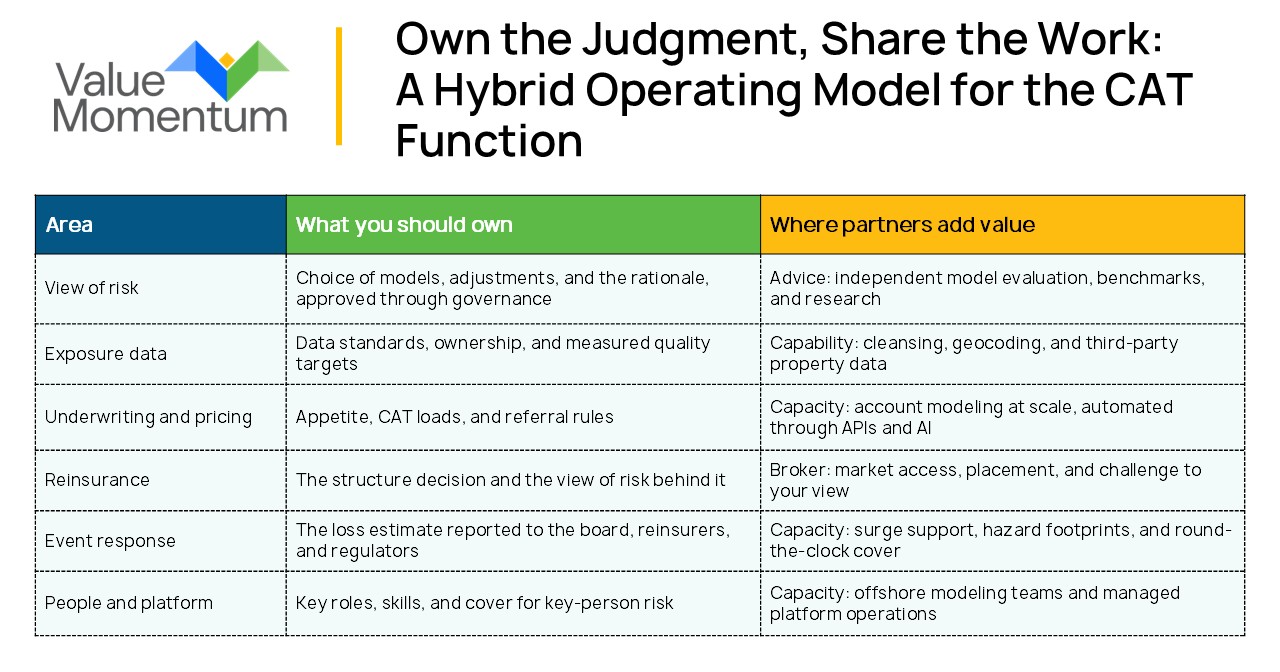
A simple test shows whether you own your view of risk. Could you change your broker, model vendor, or service provider next year without your view of risk changing with them? If not, you are renting it.
Four Obstacles to Owning Catastrophe Risk
If you have not yet taken ownership of your CAT risk, the obstacles are likely familiar. Each is real, and each has a practical answer:
- The operating model dilemma. In-house, outsourced, or hybrid is a question of strategy, cost, and control, not a binary choice. For most midsize carriers, the answer is a small senior core, often a head of exposure management and a model evaluation lead, that owns judgment and governance. Production capacity comes from a partner, and your broker provides market insight and challenge.
- Skilled CAT modelers are scarce and heavily outnumbered by actuaries, underwriters, and agents. India has become a global hub for CAT risk expertise and is home to the majority of the world’s CAT modelers. They work across capability centers set up by carriers, brokers, and model vendors; technology and analytics companies; and boutique specialist firms. You don’t need to build your own presence there to use this talent. Working with an established partner gives you access to experienced modelers, scaled to the work and backed by deep bench strength.
- Data quality. Exposure data quality is the top challenge presented in Aon’s report, with survey respondents rating their secondary modifiers just 2.41 out of 5 and over a third (36%) doing nothing to augment their data. Third-party property data and cleansing tools can greatly improve results, especially when they target the most hazard-prone locations and the inputs models are most sensitive to.
- Model limitations. Every model has its own assumptions and blind spots, so the key question is whether it is fit for purpose for your portfolio, peril, and use. Building a full model is beyond most carriers, but, as the Oasis authors suggest, targeting the specific inadequacies of vendor models can help bridge existing gaps. Open platforms, such as Oasis, give access to models from more than 18 suppliers, which makes a second opinion more affordable.
While these obstacles are real, they are not insurmountable. With strategic planning, you can address each of these four areas to bring your view of CAT risk in house, without needing to provide all of the resources or capabilities. An owned CAT risk function addresses these challenges to proactively understand and mitigate exposure.
The Six Pillars of a Proactive Catastrophe Function
What does an owned function do differently? The six pillars below describe the capabilities your CAT function itself must hold. Building true resilience, however, requires these pillars to connect to other functions across the enterprise, such as underwriting, exposure management, mitigation, and claims. CAT risk advisory sits at the center and turns model output into decisions.
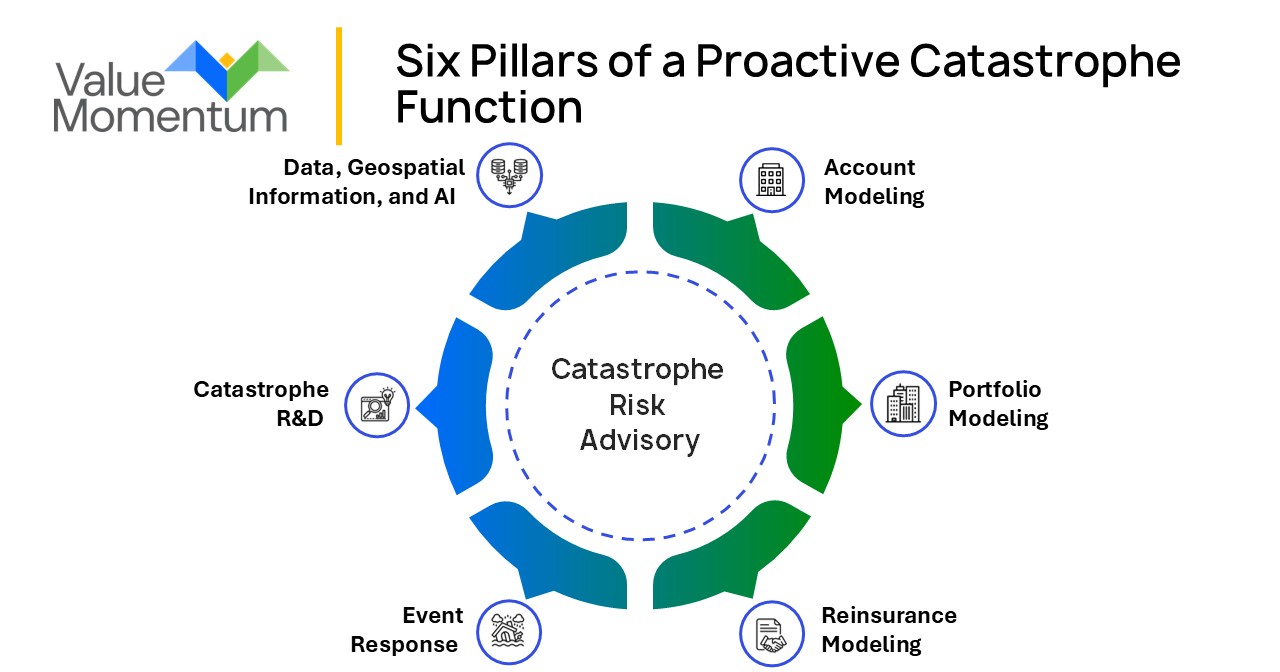
Here are the six core pillars of a proactive approach to CAT risk:
- Account Modeling
Passive account modeling for underwriting means CAT loads are set by rule of thumb, with accumulation found after binding. In an owned function, you see the modeled cost of a CAT and the marginal impact on your portfolio before you bind.
- Portfolio Modeling
In a passive function, exposure management is assessed through an annual snapshot that is produced for the renewal. In an owned function, you assess exposure through regular, in-house runs of accumulations against appetite and limits.
- Reinsurance Modeling
In a passive function, reinsurance decisions rest on your broker’s models and analytics. With your own view of risk, you can test retentions, limits, and alternative structures yourself.
- Event Response
When it comes to claims staffing and incurred-but-not-reported (IBNR) losses, a passive function has to wait for broker or industry estimates to arrive. In an owned function, you can deliver first loss estimates within a few hours and refine them as claims arrive.
- Catastrophe R&D
If you do not own your view of risk, you are accepting vendor defaults as-is. If you have taken accountability in house, you can regularly test adjustments and loads for non-modeled exposure by undertaking model evaluations.
- Data, Geospatial Information, and AI
Rather than manually cleansing data before every run, you can design your systems for measured data quality, with enrichment, geocoding, and AI-assisted automation across the process.
The pillars reinforce each other, and the gaps in a passive model are greatest at the two ends. At the front end, account modeling puts CAT cost into the underwriting decision before the risk is bound. At the back end, event response is not just a communications exercise. For example, most Aon survey respondents use CAT response tools for internal loss reporting (65%), to inform their claims operations (64%), and for loss reserving (60%). If you borrow your event response, you are setting staffing and IBNR on borrowed numbers.
Where to Start: Four Steps to an Owned Catastrophe Function
Moving from a passive approach to CAT risk management toward an owned function does not happen overnight. Ownership is built in steps, each of which creates its own value while preparing the ground for the next:
- Take back your data. Set exposure data standards, assign owners, and measure quality. Every other step depends on this.
- Bring the portfolio view in house. License a model or access one through a vendor’s hosted platform. Run your portfolio regularly and test how well the model fits your own claims.
- Push catastrophe insight to the point of underwriting. Start with pre-bind account modeling for your most CAT-exposed segments, where the effect on volatility is greatest.
- Build your own view and take it to the renewal. Document adjustments for model weaknesses and non-modeled exposure. Use your broker’s view as a challenge to yours, not as a replacement.
At each step, decide what to own, what to source, and what to share, then revisit that decision as your book and the market change. Above all, keep asking the question this blog opened with: Whose number is it? If your broker or model vendor changed tomorrow and your view of risk would change with it, the number your board sees is still someone else’s.
Ready to learn more? Watch Adityam Krovvidi’s video “The Essentials of Modern Catastrophe Modeling.”