


Across insurance, four distribution priorities consistently rise to the top: expanding market share, maximizing channel performance, improving operational efficiency, and enhancing the experience for agents and customers. As competitive pressure increases and product differentiation narrows, insurers are placing greater emphasis on the distribution touchpoints that directly influence how business is placed and serviced.
Recent market data reflects this shift. The global insurance agency portal market reached approximately $6.1 billion in 2025, driven by insurer investment in digital tools that streamline agent workflows. Distribution modernization, especially intuitive, consistent broker and agent experience, is a strategic imperative for P&C carriers.
Agent portals play a central role in that experience. They are no longer just access points to core systems, but the primary environment where agents quote, bind, service policies, and track ongoing business. How effectively these portals engage agents directly impacts channel performance, operational efficiency, and, ultimately, growth.
How Are Insurers Successfully Modernizing Their Agent Portals?
When portals introduce friction or force agents to rely on email, phone calls, or parallel systems, inefficiencies surface quickly and influence where agents place business. To meet rising expectations, insurers are organizing agent portal capabilities along a clear maturity spectrum: table-stakes, advanced, and differentiated capabilities.
Every agent portal must support basic submission, inquiry, and transaction workflows while providing the core servicing functions that enable agents to conduct their day-to-day business. More advanced capabilities build on this foundation by reducing friction and operational effort through streamlined question sets and faster quote-to-bind workflows or increased self-service options such as endorsements and certificates of insurance.
Going beyond these levels of portal functionality is how insurers can create differentiated experiences that provide an engaging, modern experience for agents. In our recent ValueMomentum webinar, I spoke with Kim Bandeko, AVP, IT at Pekin Insurance, to learn about their modernization journey as well as to discuss broader patterns we have observed across insurer distribution initiatives.
Here are some practical considerations insurers can apply to their own agent portal modernization journeys to provide an agent experience that drives growth.
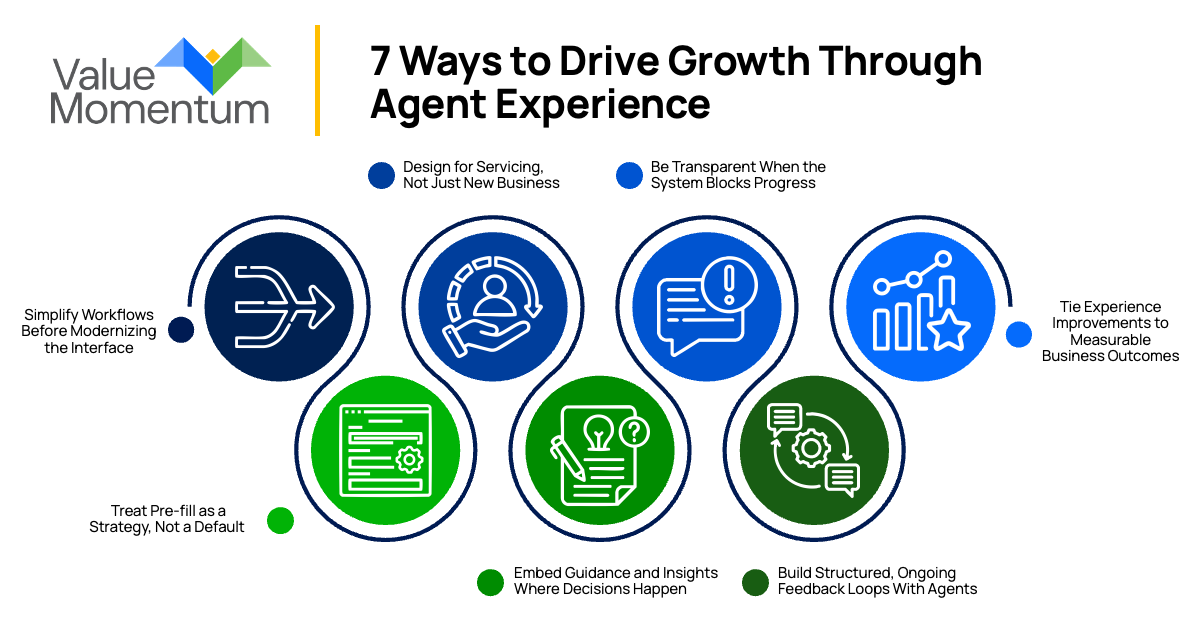
1. Simplify Workflows Before Modernizing the Interface
Agent experience issues are often rooted in process complexity rather than visual design. Long question sets, repeated data entry, and unclear handoffs slow quote and bind and increase abandonment, especially when agents are comparing multiple carriers at once.
Pekin Insurance’s modernization effort reflected this reality. Before investing in a new agent interface, the team focused on simplifying workflows by reducing unnecessary questions, aligning with underwriting on required inputs, and prioritizing straight-through processing. This sequencing prevented inefficiencies from being rebuilt into new digital experiences and created a stronger foundation for later enhancements.
2. Treat Pre-fill as a Strategy, Not a Default
Pre-fill can reduce agent effort and accelerate quote completion, but it is not universally beneficial. Each pre-fill call introduces cost, data-quality risk, and governance considerations, particularly in commercial lines where external data may be incomplete or outdated. Used indiscriminately, pre-fill can create friction rather than remove it.
Insurers are increasingly being encouraged to approach pre-fill more selectively, evaluating when agents should be able to override pre-filled data, how discrepancies are surfaced, and where pre-fill delivers the highest return based on risk type and likelihood of bind. Treating pre-fill as a strategic investment helps balance speed, accuracy, and cost while preserving agent trust.
3. Design for Servicing, Not Just New Business
While new business often gets the most attention, servicing activities consume a significant share of an agent’s day. When portals fail to support these workflows, agents default to email and call centers, increasing operational cost and eroding experience.
In practice, successful modernization efforts account for this reality by ensuring servicing is part of the portal modernization roadmap, rather than being deferred until after sales workflows. This approach aligns with broader industry observations. Carriers that enable self-service options reduce inbound support volume while improving agent satisfaction. Designing for servicing ensures portals support the full life cycle of agent work, not just the moment of bind.
4. Embed Guidance and Insights Where Decisions Happen
Modern agent portals create the most value when they help agents make better decisions in the moment. Appetite guidance, prioritization signals, and contextual insights are most effective when they are embedded directly into quoting and servicing workflows, rather than surfaced in separate reports or dashboards.
Agents are constantly deciding which submissions to pursue, which accounts to prioritize, and how to respond to underwriting constraints or market shifts. When guidance is delivered at the point of action, portals move beyond transaction processing and become decision-support tools. This helps carriers influence submission quality, conversion rates, and portfolio performance without adding friction.
5. Be Transparent When the System Blocks Progress
Few things erode agent trust faster than unexplained errors or silent submission failures. When portals block progress without a clear justification, agents are left guessing why a risk cannot proceed and often abandon the submission altogether. Transparency matters.
Clear error messaging, plain-language explanations, and guidance on next steps help agents understand underwriting constraints rather than perceive the portal as an obstacle. When agents know why a submission is blocked and what can be done to resolve it, portals reinforce confidence and reduce unnecessary back-and-forth with underwriters or support teams.
6. Build Structured, Ongoing Feedback Loops With Agents
Agent portal modernization should not be treated as a one-time launch. Structured feedback loops — grounded in agent personas and regular engagement — help insurers validate assumptions before scaling changes.
Advisory groups, targeted pilot programs, and iterative feedback sessions allow carriers to test improvements early, adjust course, and reduce rework. Just as importantly, these mechanisms signal to agents that their input matters, strengthening adoption and long-term engagement.
7. Tie Experience Improvements to Measurable Business Outcomes
Experience investments gain traction when their impact is clearly understood. Metrics such as quote-to-bind ratios, agent experience scores, submission completion rates, and premium growth help insurers connect portal enhancements to tangible business value.
When experience improvements are linked to outcomes that matter to distribution and leadership teams, modernization efforts are easier to prioritize and sustain. This discipline also helps insurers focus investments on capabilities that deliver measurable returns rather than incremental feature expansion.
When portals evolve from fragmented, transactional tools into cohesive, insight-driven experiences, they stop being just another system to maintain and become a lever for growth, efficiency, and stronger agent relationships.
Designing Agent Portals for What Comes Next
Insurers that modernize with intent — by simplifying workflows before scaling features, embedding guidance where decisions are made, and tying experience improvements directly to business outcomes — are better positioned to succeed.
As agent expectations continue to rise and distribution models evolve, a deliberate, outcome-driven approach to agent portals will determine which carriers earn long-term preference and loyalty.
To dive deeper into the world of modern agent portals and learn how to leverage a portal strategy that meets agents’ expectations, watch our on-demand webinar, “Ask the Experts: Modern Agent Portals: Elevating Experience and Driving Profitable Growth.”