

The conversation around insurance core system transformation has changed over the last few years. Insurers are either moving or have already moved from on-premises deployments to cloud-based systems. Now, as artificial intelligence (AI) becomes a standard part of modern insurance technology systems, carriers are looking for ways to enhance their core systems value realization.
Getting the real value out of an insurance core system means that the platforms underlying a carrier’s business can help transform operations, rapidly develop new products that meet customer needs, and efficiently roll out in new states to expand market reach. AI is helping insurers get the most out of their core system investments across all of these goals.
The Business Impact of AI for Core Modernization
Core modernization efforts deliver significant business and bottom-line benefits, and leveraging the latest AI technology from both core system vendors and trusted partners can help insurers realize those benefits more efficiently and rapidly. Here are three examples:
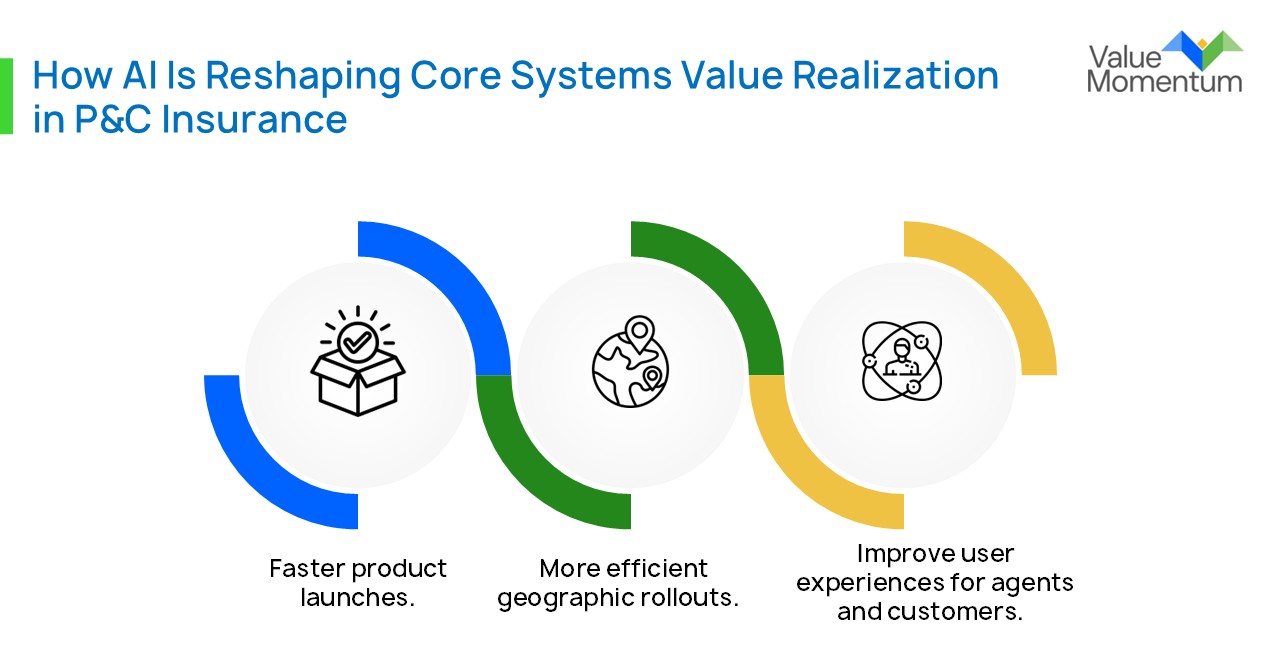
1. Faster product launches. Two or three years ago, if an insurer wanted to launch a new product, the process from first step to product launch could take 32–46 weeks. The newest cloud software, applications, and AI technologies have shortened this timeline to 16–20 weeks, with product definition in as little as two to three weeks. Modern core systems support configurable, reusable product development, allowing insurers to deploy new policies quickly to meet emerging needs, build new packages for changing customer profiles, or offer microinsurance options by breaking down existing offerings.
2. More efficient geographic rollouts. Insurers are seeing the same timeline acceleration benefits when rolling out existing products in new regions. The same facets of a modern core system that simplify product development make it more efficient to update those existing products for regional specifications and compliance requirements.
3. Improve user experiences for agents and customers. Time and cost savings from product development and rollout improvements let insurers devote more time and resources to business needs, high-value projects, and high-level strategy. It’s not just policy, billing, and claims systems that benefit from a modern platform and AI capabilities. Carriers are investing in enhanced agent experiences to expand their market reach, improve growth and retention, and deliver customers a better experience via more informed, engaged agents.
New systems are a strong starting point, but insurance leaders must do more to ensure they are using their core systems to their fullest potential, ensuring greater flexibility and agility, enabling the incorporation of leading-edge tools, and reducing operational costs. This is where AI comes in.
How AI Is Leveraged in Core System Transformation
Modern core systems are ripe for AI-driven optimization and enhancement. Some of these techniques have been used by insurers for years. For example, machine learning algorithms can automate basic but time-consuming tasks, and robotic process automation can help eliminate manual errors.
AI has evolved rapidly over the last few years, however, and insurers are investing in newer technologies like generative AI (GenAI) and agentic AI. Many carriers are using AI-led solutions across the property and casualty value chain, and the number of organizations investing in AI-powered systems and tools is only going to grow. ISG research found that 83% of insurance leaders across functions are willing to leverage AI for repeatable work, provided humans remain in the loop for high-value decision-making and oversight.
Leveraging AI for core modernization is already helping insurers get the most out of their modern systems faster than ever. There are two main ways leveraging AI can support insurer core system transformation efforts: using the solution’s built-in AI capabilities or relying on the strategic AI insights and expertise that systems integrators (SIs) can bring.
- Built-in AI capabilities. Most leading core systems vendors offer solutions with built-in AI tools. These capabilities depend on the vendor’s AI roadmap and strategic vision for its product and end users. Guidewire, OneShield, Duck Creek, and Insurity, for instance, have all incorporated AI capabilities directly into their core platform offerings.
- Strategic partner AI expertise. Having AI capabilities at your disposal and knowing how and when to use them are two different things. Strategic partners like ValueMomentum can help insurers work with a platform’s AI capabilities as well as bring additional tools, frameworks, and expertise to enhance and personalize how insurers get the most out of their core system investments.
Together, these two ways of leveraging AI create time and cost efficiencies that can help insurers optimize their operations. By leveraging AI, automation, and the data-rich, cloud-enabled capabilities of modern core systems, insurers can transform time- and resource-intensive development cycles into rapid, data-driven processes using GenAI, predictive analytics, and agentic workflows. This includes use cases like:
- Test case automation: Instead of having quality assurance (QA) teams manually create test scripts from requirements and actuarial guidelines, AI can generate test cases from plain-English prompts, existing insurer documentation, and real or AI-generated customer data. In the requirements testing phase, insurers can leverage tools such as GitHub Copilot to generate boilerplate code. Insurers can then use AI to generate unit test cases by writing prompts based on the results of requirements testing.
- Ensuring regional compliance: When entering new markets, insurers can use AI tools to quickly ingest regional risk data and regulatory guidelines, accelerating the time it takes to understand the new market’s risk baseline and local context.
- Intelligent risk management: AI can help optimize premium calculations in new and existing regions by combining historical claims records, predictive behavioral analytics, and market intelligence. Insurers can also leverage predictive AI models to make their risk and scenario simulations more dynamic and attuned to real-world stressors and shocks, such as natural disasters and macroeconomic trends.
Every insurer has different needs and requirements, and no core system vendor’s solution has every possible feature and function out of the box. Solution approaches are still critical for driving tangible business outcomes.
Deciding which vendor solutions are the best fit for an organization, how to use them most effectively, and when and where to leverage AI are all important considerations. Insurers must avoid over-engineering, incorporating AI into business processes thoughtfully while maintaining human oversight.
Realizing Value With Humans in the Loop
Human expertise is more relevant than ever. Insurers still need people to review AI-generated output and make the final call on high-value, consequential decisions. In the test case automation use case above, for example, a senior developer must still ensure the AI-generated boilerplate code functions properly and doesn’t break existing rating logic. Anything AI generates must still account for industry and regulatory requirements and align with the insurer’s strategic vision and business goals.
SIs can partner with insurers to help them leverage AI and automation across development, testing, rollout, and beyond. Insurers hoping to get the most out of their core system modernization investments should create AI adoption plans across accounts; test and pilot AI tools, features, and functions; and scale accordingly based on use cases and strategic business goals.
To see how carriers are realizing the most benefit out of their core system investments, read the case study, “Super-Regional Carrier Accelerates Commercial Lines Business Growth With Guidewire Cloud Platform.”