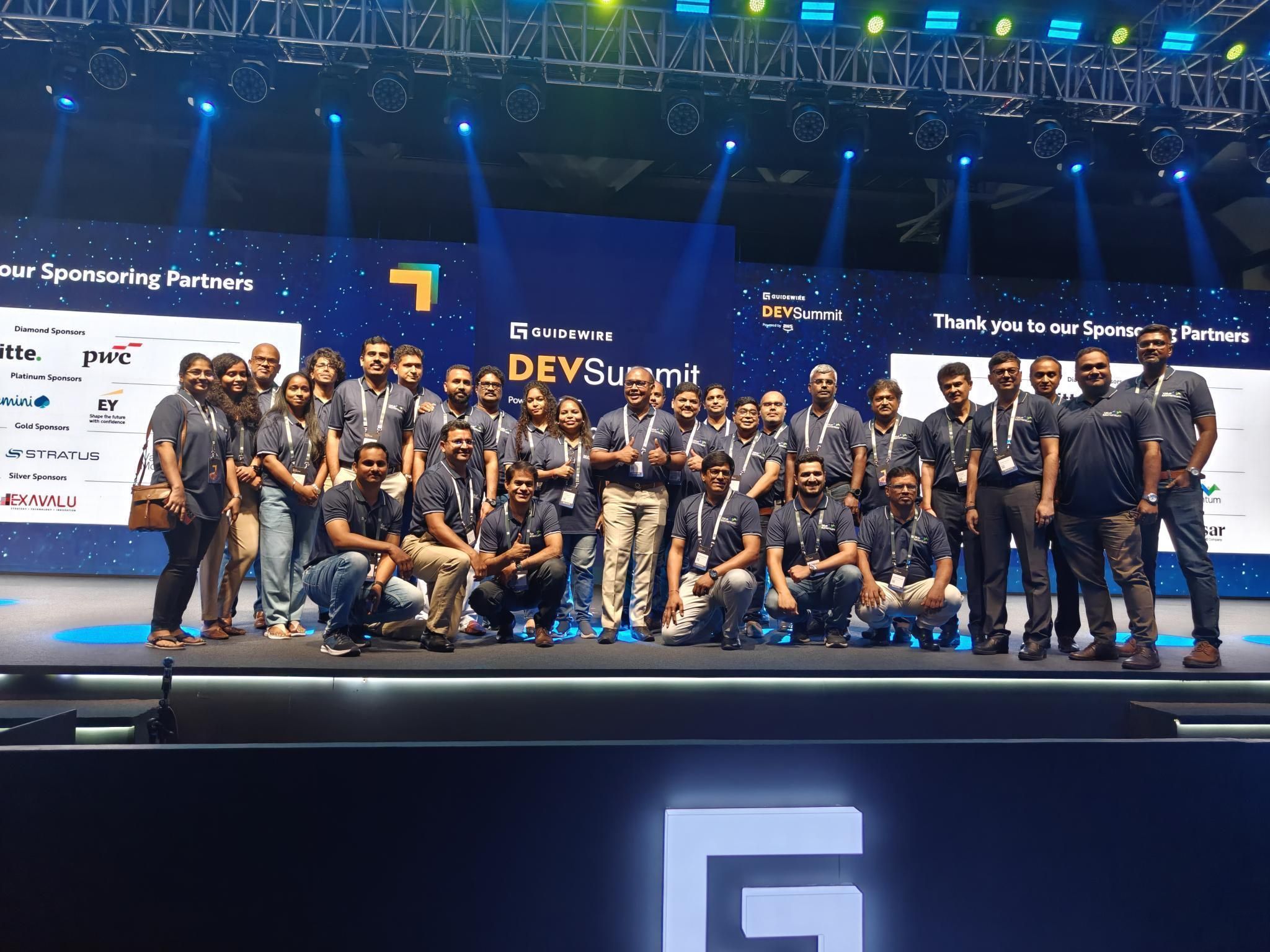


The last week of October, the ValueMomentum team and I gathered with thousands of other property and casualty (P&C) insurance technology professionals at this year’s Guidewire Connections conference. Participants shared knowledge, exchanged best practices, and learned what new Guidewire capabilities are shaping the way insurers drive value for their customers.
The conference also included a wide range of practitioner-led discussions on critical technology initiatives P&C carriers are executing that are showing real business results, spanning from modernizing claims workflows to enhancing analytics capabilities to drive AI decision-making. I was fortunate to moderate one of these sessions, featuring two speakers from COUNTRY Financial: VP and Chief Product Officer Jeremy Brewer and Principal Program Manager Brian Scottberg.
In this panel discussion, Jeremy and Brian walked me through the realities of a successful commercial lines transformation: the business drivers, technology capabilities, lessons learned, and best practices for other insurers.
Best Practices for a Successful Commercial Lines Transformation
Most insurers are dealing with complex legacy systems, supporting applications, and third-party partner and data platforms, all intertwined to support numerous lines of business and various states. Transforming the core infrastructure underlying an insurance enterprise is no simple task, but best practices can guide these efforts and steer carriers toward success.
Here are five best practices shared during the panel discussion:

1. Turn collaboration into a strategic lever.
The overall goal of this transformation effort was to deliver a leading agent experience that would translate into commercial lines growth. Streamlining the process, simplifying screens, and lowering the barrier to entry empowers agents to better understand an insurer’s offerings and sell them more effectively. Having this clear end-state vision also enabled all of the project’s stakeholders to unite behind a common mission.
Collaboration played a vital role in the success of this program, the speakers stressed. Using a “ONE TEAM” approach makes sure that there is no “business vs. tech” mindset at play, but instead all stakeholders are aligned to the end goal. Structuring every interaction, meeting, and project standard around this “ONE TEAM” mindset helps cut out hierarchical rigidity and accelerate decision-making. Equally critical was building in end user feedback right from the start. In this case, it meant getting direct feedback from agents along every step of the process and adjusting or pivoting based on those inputs.
2. Take the time to understand gaps between the current state and the proposed future state.
Insurers are dealing with decades-old core systems that have layers of quick fixes, integrations with new systems, process customizations, workarounds, and more piled on top of them. In most cases, a simple “rip-and-replace” approach is both impractical and infeasible. Successfully executing a major transformation requires insurers to take a step back and think critically about how their current state actually functions before forging ahead.
For this project, COUNTRY Financial prioritized three major capabilities for its future state. It needed to be built with client-first design, ensuring that agents could fill out a simplified form regardless of the quote they were seeking and feel like they truly understood the coverage. The new system needed to be able to integrate with third-party data platforms to optimize processes and enable better decision-making. And it needed to be built with scalability in mind, especially as AI capabilities continue to evolve rapidly.
3. Invest in a strong foundation for both technology and process.
Any core modernization is inevitably rooted in cloud-based systems as we near 2027, but another critical component for transformation is preparing for simple integrations with partner platforms, third-party data, and future capabilities like AI tools. In this transformation, Guidewire’s Jutro Digital Platform served as the backbone for building out a leading digital experience, but Brian and Jeremy emphasized that strong processes are just as important as leading technology capabilities.
Training team members to be comfortable not only with the tools being used but also with methodologies like SAFE Agile can play a major part in the success of a transformation effort. Teams need to understand what good looks like before handoffs are made. The same goes for project scope. Is it possible for an insurer to launch a transformation for all of their lines of business and states at once? It could be. But starting with a less complex line of business in a smaller market can help the project teams test out design, get feedback from key stakeholders (in this case, agents), and then adjust their approaches before moving on to the next line of business with those learnings in mind.
4. Don’t shy away from leveraging AI.
AI remains a hot topic across the industry for a reason as insurers of all sizes become both more comfortable and more familiar with how to leverage AI capabilities most effectively. AI-powered tools like Jutro can improve development timelines by 25-30%, and use cases like AI-driven code generation and test case automation can drive real dividends on long-term projects like commercial lines transformation.
As agentic AI gains a stronger foothold, insurers can look at how to orchestrate AI agents for use cases like test case automation, defect triage, and cross-analysis to free up human resources for more strategic work. AI can also help analyze critical end user feedback to identify the type of questions being asked, where agents are getting stuck in the process, and how usage is changing as new features are launched. All of these use cases can analyze behavior and feedback in real time, then apply changes independently.
5. Pick your strategic partners wisely.
The COUNTRY Financial team emphasized the value of picking transformation partners with intention, since these projects typically run for years and involve lots of time spent together. “It’s critical to choose someone you trust, who trusts you,” Brian said, “Someone that you can be candid with and hold each other accountable for driving successful business outcomes.”
Strategic partners need to be able to help guide strong governance processes and have checks and balances in place to measure how the team is actually performing and where challenges are emerging. Insurers should keep in mind that transformation efforts are more than just a technology implementation; they encompass processes, end user interactions, communication practices, and more. A good strategic partner should be able to navigate all of these aspects, build accompanying processes, and communicate about the transformation to yield real results.
Any transformation initiative is a complex undertaking, and each insurance organization has its own technological and cultural contexts that should be taken into consideration. But the best practices shared during the panel discussion at Guidewire Connections 2026 can help P&C carriers of any size plan and execute a core transformation effectively.
To learn more about how insurers are transforming their digital experiences and core systems, read our whitepaper Unlocking Better Digital Experiences With Jutro Digital Platform.