


Insurance leaders rarely lack the ambition to modernize. But what they often do lack is a complete understanding of what they are modernizing before they commit to changing it.
According to Boston Consulting Group, 74% of transformations fail in the insurance industry. It’s not because of the tools, which continue to make innovation and implementation more accessible than ever. Carriers preparing to modernize their claims platform, for example, can generate code and integrate with disparate data sources faster than at any previous point in the history of insurance.
What’s harder to see, however, is all of the factors embedded in how the claims process already works, and what breaks once that process changes. This disconnect is what most often separates a successful transformation from a multi-year write-off. With AI adoption accelerating, insurers need to fix the gap between knowledge and execution if they’re going to succeed.
Where Modernization Goes Wrong
Much of the pressure insurers feel to modernize quickly comes from a reasonable place. Legacy policy, billing, and claims systems are expensive to maintain, difficult to integrate with, and increasingly unable to keep up with market changes. But the instinct to move fast often runs into an obstacle that has nothing to do with technology choice, cloud readiness, or vendor selection.
Before a capability can be safely changed, the organization has to understand how that capability actually works. That understanding is rarely absent from the enterprise, but it isn’t recorded in an easily searchable location. Some of it is housed in code no one has touched in the years since the system went live. Oftentimes it lives in the people who have quietly worked around the system’s quirks for years without ever documenting those workarounds.
And that disconnect is where transformation timelines go sideways. Teams regularly spend more time rediscovering how a legacy system operates than they do building the new system, tracing dependencies that were never mapped and reconstructing rules that were never written down where a project team could find them. That work rarely shows up as a line item in a project plan, but it’s often the real reason a modernization initiative that should take 18 months stretches into its fifth or sixth year.
Before committing capital and organizational bandwidth to a major change, insurance leaders can pressure-test their readiness by asking four questions.
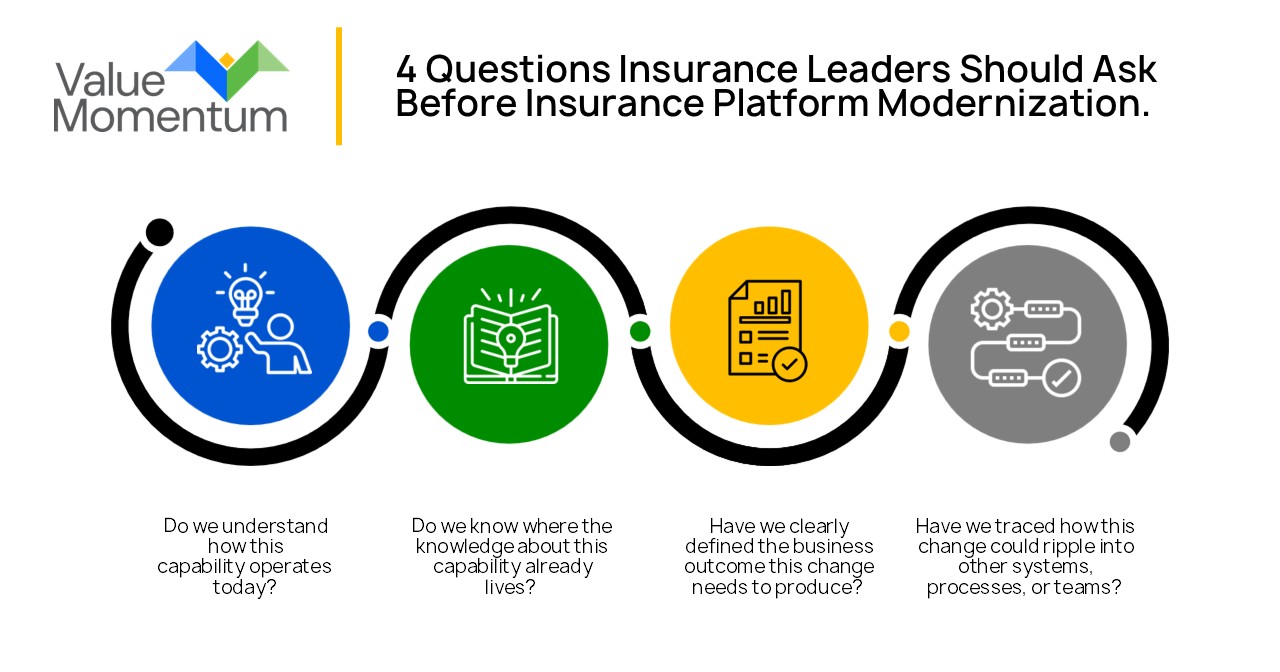
1. Do we understand how this capability operates today?
Knowing how the capability actually operates goes beyond naming the primary system involved. It means knowing the other systems that participate in the process, the rules and data flows that have accumulated within it over time, and the dependencies that aren’t obvious from the outside until something changes.
Discovery isn’t a formality; it’s the phase that determines whether the transformation that follows is grounded in reality or built on assumptions that will unravel later. Let’s take a team preparing to modify their claims adjudication process, for example.
The systems involved might already be well documented. What’s harder to find is the reasoning behind each decision. Why does an adjuster escalate certain claims and not others? Which manual workarounds have quietly become standard practice? What downstream reports will break if a single data field is changed? A platform can be fully mapped while the logic running on top of it remains almost entirely unwritten.
2. Do we know where the knowledge about this capability already lives?
Most insurers can point to isolated pockets of expertise, such as a claims examiner who has handled every complex subrogation case for a decade or an old requirements document buried in a shared drive that no one remembers to check. Few have mapped those pockets into something a project team can actually draw from when a change is first scoped.
The risk isn’t that the knowledge disappears overnight. It’s that no one thought to locate it until the project was already underway. In fact, P&C insurance is projected to lose nearly half its workforce to retirement within five years, with 93% of insurance CxOs already rating that knowledge loss as mission-critical.
This is why a growing number of carriers treat a current-state knowledge audit as its own deliverable rather than an informal first step. Ahead of a major data modernization effort, one of our clients formed a dedicated governance committee that spent its first six months documenting what the organization already knew before proposing what should change. Treating knowledge location as a deliverable, not an assumption, helps separate insurers who modernize on schedule from those who discover gaps mid-project.
3. Have we clearly defined the business outcome this change needs to produce?
At a recent Datos Insights industry panel on core system transformation, one insurance IT leader described a replacement that had stretched to 15 years, attributing the delay to entering the project without an agreed-upon execution strategy.
Building a strong business case for a technical change requires fully answering why the change is needed or what outcome justifies it. That business case should be supported by a connected view of how the capability is actually performing, not disconnected reports or intuition carried over from the last transformation.
Without that clarity, modernization initiatives risk drifting from a defined strategy into a costly lift-and-shift replacement, with stakeholders never fully aligned on what the finished project was meant to achieve.
4. Have we traced how this change could ripple into other systems, processes, or teams?
Few capabilities operate in isolation. A change to policy issuance can quietly ripple into billing, claims, and reporting, disrupting every team that depends on those systems without warning. This is part of why insurers have increasingly moved toward modular, loosely coupled architectures, which limit how far a single change can spread in the first place. But modern architecture doesn’t remove the need to trace those effects up front.
These effects extend beyond internal systems, too. Regulators, distribution partners, reinsurers, and outside data providers often depend on a capability behaving exactly as it did before a change was made, even when they’re never named in a project’s technical scope. One symptom of skipping this mapping shows up well after go-live: In 2022, Accenture documented a carrier where an underwriter was required to use 92 different digital solutions in a single working day, the kind of sprawl that accumulates when each change is evaluated on its own, without asking what else it touches.
None of these four questions requires new technology to answer. They require treating understanding as work that happens before a transformation begins, not as a problem discovered once it has already stalled.
Understanding as the Real Differentiator
Insurers don’t fail at major change because they lack the tools. Cloud platforms, AI, and modern development practices have made construction faster and more accessible than at any point in the industry’s history. What derails a transformation is rarely the system being replaced; it’s the assumption that a team already understands it well enough to change it safely.
The four questions above won’t remove every risk from a major change. What they do is move that risk earlier, starting a conversation before commitments are made. Insurers who prioritize understanding how their systems and workflows operate before diving into a transformation effort have a much clearer path ahead of them.
To learn more about successful approaches to P&C modernization, read our case study “HAI Group Drives Efficiency and Delivers Enhanced Customer Experience With Core Modernization.”