

Artificial intelligence (AI) capabilities have become a regular component of the average property and casualty (P&C) insurer’s operations and core systems. The technology shift of the last few years has led to an evolution in the discussion around core systems. Carriers aren’t focused on figuring out when and how to migrate to the cloud anymore. Instead, cloud is a given, and they are focusing on AI enablement and learning how to best leverage cloud-native features.
KPMG found that 77% of insurers think that if they don’t rebuild their enterprise architecture to account for AI, their competitive position will be undermined within five years. To succeed in today’s market, insurers need the security, speed, and efficiency that cloud-native, AI-powered core systems can provide:
- Better security from automatic software updates and vendor maintenance, real-time anomaly and suspicious claims detection, and stronger identity verification and access management
- Faster growth from rapid product launches and low-code/no-code configuration, API-enabled integrations to third-party data ecosystems, and faster time to market for new products and geographies
- More efficient workflows with generative and agentic AI, straight-through processing for faster claims and underwriting, and a reduction in time- and resource-intensive manual processes
AI-powered core systems afford insurers greater agility when bringing new products and enhancements to market and responding to industry and economic change. They also help insurers serve customers better. With their more diversified, distributed architecture, insurers can reduce latency, digitize critical touchpoints, and scale performance during business spikes and busy seasons.
Every insurer has different needs and requirements, and the AI features provided by core systems vary from platform to platform. Some vendors are focused on agentic AI and predictive modeling to automate routine work across the P&C value chain, while others have prioritized building separate system-agnostic AI layers insurers can integrate for a variety of core functions.
Optimizing the Use of AI for Core Modernization
No matter the strength of an organization or platform’s AI capabilities, without an intentional, well-defined roadmap, even the most advanced core systems implementation can be a complex journey for insurers.
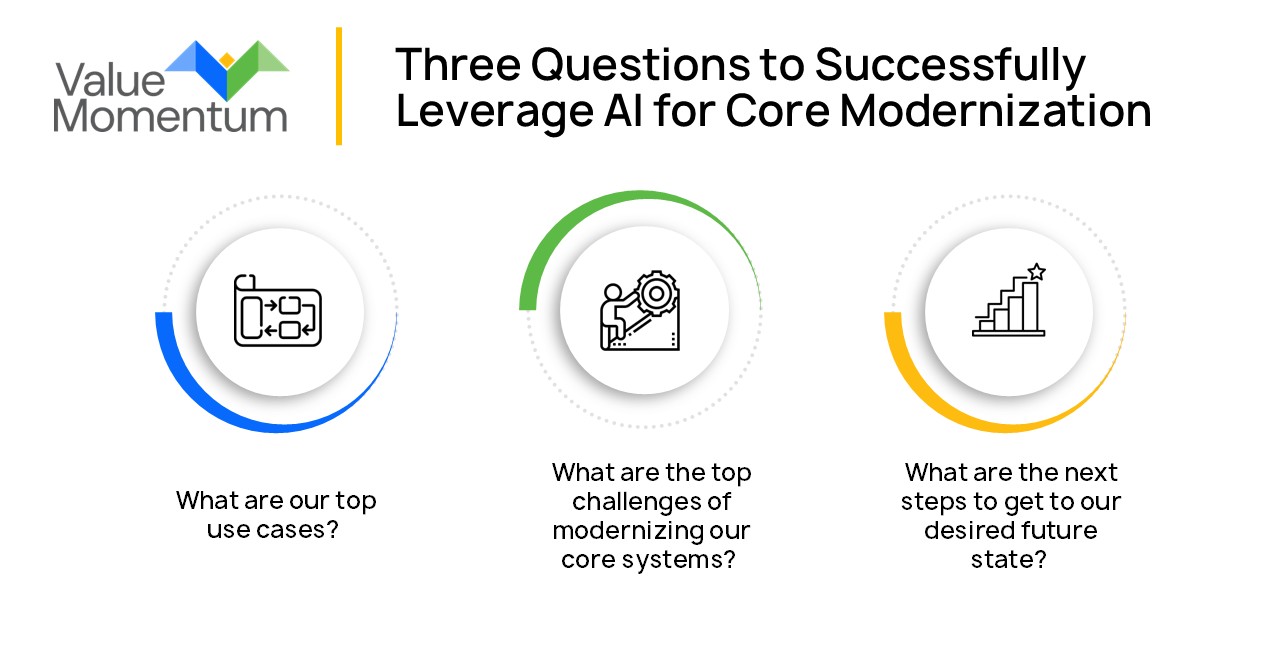
The answers to three questions will help them plan and implement changes while avoiding increased maintenance costs, underutilized functionalities, and more technology debt. Before embarking on a core modernization project, insurance leaders must ask themselves:
1. What Are Our Top Use Cases?
Limiting the initial project scope to two or three high-priority areas reduces the complexity and risk of the larger core modernization project. Insurers should identify their top use cases, prioritizing areas that will deliver the greatest up-front benefits and serve as a model for continued expansion.
Insurers could start with a particular system, such as policy and billing, or focus on a few key lines of business. This phased approach lets insurers develop, test, and validate new systems, architecture, and functionality against a discrete set of use cases. It also enables insurers to build the strong data foundation needed to scale to additional products and other areas of the core technology stack.
HAI Group replaced its 30-year-old, homegrown core platform with a cloud-based core system and CCM platform in under two years. By starting with its general liability and excess lines of business, HAI Group ensured the transformation was completed successfully so it could roll out additional lines of business more quickly. The repeatable framework it established allowed HAI Group to roll out all lines of business within a year of initial go-live.
2. What Are the Top Challenges of Modernizing Our Core Systems?
Often, insurers developed their core systems over years (or even decades) in several phases and with multiple layers of technology. These tightly coupled, on-premises systems can be hard to adapt because they lack the agility and scalability needed to integrate seamlessly into modern cloud environments.
Moreover, insurer core systems contain myriad documents, rules, and structured and unstructured data, adding to the complexity. Compatibility issues, data corruption, and operational bottlenecks are common issues when migrating data from these systems to the cloud.
Understanding the current state of core systems and anticipating upcoming challenges helps insurers prioritize where automation can reduce migration-related risks, improve data accuracy, and speed up the core transformation process. Automating data mapping, transformation, and validation reduces the risk of corruption and compatibility issues. It can also help clean and structure historical data before migration, ensuring everything meets the new system’s requirements. The benefits extend to ongoing data synchronization between the old and new systems, ensuring business operations continue without disruption during the transformation.
3. What Are the Next Steps to Get to Our Desired Future State?
After investigating top use cases and identifying potential modernization challenges, insurers should examine their findings and develop a practical view of what it will take to achieve their desired future state. For example, a specialty carrier ValueMomentum worked with had a robust modernization plan that addressed different core capabilities in phases. For the claims component of this initiative, the insurer wanted to automate workflows where possible, leveraging intelligent document processing (IDP) with human-in-the-loop validation to cut down on manual workflows and establish a framework for future AI-based workflows across the value chain.
Transformation projects look different for insurers that already have some cloud-native systems in their core suite vs. those with some or most of their systems in on-premises deployments. In the case of the specialty insurer above, having a cloud-based core system in place meant that it was ready to begin incorporating AI-powered workflows across the enterprise after proving out the concept with a critical initial use case.
These answers will inform whether insurers upgrade existing platforms and improve their integrations with other systems or if they decide to move to a new system altogether. Carriers need to assess whether the process will require data migration and the current level of connectivity, if any, between current-state systems.
Insurers should approach core transformation as a continuous journey rather than a project that ends after completing the initial implementation. The new system must be flexible enough to accommodate future upgrades, new technologies, regulatory changes, and business initiatives.
Modernizing for an AI-First Future
AI technologies and use cases will continue to emerge and proliferate across industries to enhance their operations while increasing efficiency and accuracy. The insurance industry, though risk-averse by nature, is no different.
Carriers are already using AI-enabled solutions across the property and casualty value chain. With AI and automation, core transformations are already taking two years instead of five, and those implementation timelines are accelerating. Some carriers are completing projects in two to three months that, in the recent past, took six months to a year. Once insurers see how and where AI technologies drive results, they will expand the scope accordingly.
Systems integrators can partner with insurers to modernize core systems and add AI and automation capabilities to ongoing operations. AI adoption plans that identify the right mix of built-in AI offerings, third-party tools, and proprietary technology can help insurers test and scale approaches based on their top use cases and strategic business goals.
To see how carriers are establishing frameworks for business-driven AI implementation, read the case study, “Specialty Carrier Reduces LAE With Intelligent Document Processing.”