


It’s no secret that customer experience (CX) plays a major role in attracting and retaining customers across industries. For insurers, a significant component of CX comes down to customer communication management (CCM). Yet insurance carriers are falling behind the CX and communications standards set by other industries.
Gen Z’s satisfaction with insurance communications dropped a whopping 23 points between 2025 and 2026, according to Smart Communications’ 2026 Benchmark Report, showing that tomorrow’s insurance customers have little tolerance for bad CCM. As digital expectations continue to evolve, insurers must adapt their CX/CCM strategies to meet consumers where, how, and when they want to communicate. The first step in this process is legacy CCM system modernization.
What Does Good Insurance CCM Look Like?
Insurers still relying on legacy CCM systems are falling behind, risking attrition of current customers and pushing prospects toward competitors with nimbler systems. McKinsey research directly links insurer CX to value creation: P&C insurers with market-leading CX saw 65% greater total shareholder return, along with lower expense ratios, greater revenue growth, and higher employee satisfaction scores.
On top of helping insurers scale the multi-channel experiences that customers have come to expect, a modern CCM helps carriers improve their operational efficiency through connectivity, automation, and artificial intelligence (AI) tools. Here are the qualities that every modern CCM platform needs to include:
- Digital-first, multi-channel interactions and self-service
Consumers across generations are increasingly seeking digital-first experiences. The same JD Power research found that insurers that let customers use digital tools to file claims received higher overall customer satisfaction scores than those that didn’t.
Modern CCM systems let policyholders and prospects interact with insurers through interactive dashboards with advanced AI chatbots and voice assistants, with self-service capabilities for policy management, claims filing, and support. On the operations side, modern CCM platforms integrate with core systems to simplify the process of adding new digital channels, helping insurers proactively serve customers at their preferred touchpoints and adapt and augment channel options as preferences change and new technologies emerge.
- High connectivity and visibility
A strong, modern CCM system supports multi-channel communications across mobile apps, websites, and chatbots, but having several options is only part of the story. The strongest experiences come from connecting these channels, allowing policyholders to start communications in one channel and switch to another seamlessly mid-interaction without re-entering information.
To achieve seamless connectivity, insurers are undertaking CCM and core system modernization efforts to consolidate and integrate their data, software, and departments. Integrating a modern CCM system with the rest of an insurer’s technology stack can substantially increase cross-system connectivity and visibility, enabling the smooth, single-task, multi-channel interactions customers want.
- Personalized communications
Consumers now expect a high level of personalization when interacting with companies, especially given the curated experience they’re used to from other industries. Over the last several years, commercial and financial industries have focused on creating data-driven, tailored CX.
For insurers, meeting these expectations means moving from boilerplate policies and product recommendations to relevant, specific offers based on a customer’s personal data, preferences, risk profile, demographics, and behavior. GenAI and other leading technologies can help ease the process of customizing communications at scale.
Modern CCM systems are crucial to enabling these personalized, data-driven interactions. The speed, connectivity, and automation they afford are vital to collecting and analyzing this information quickly and accurately. The AI, predictive analytics, and machine learning capabilities of modern systems are emerging as key enablers, helping insurance companies predict customer needs, provide the right service at the right time, and improve the speed, accuracy, and relevance of communications.
How to Accelerate CCM Modernization With AI
CCM modernization plays a clear role in elevating CX and driving business growth. But upgrading a legacy platform is never an easy task. Consolidating platforms, auditing existing files, extracting logic, and rebuilding and de-duplicating hundreds or thousands of print and digital forms and templates are time- and resource-intensive tasks when performed manually.
Leveraging AI and automation capabilities can greatly reduce the time and manual effort required to undertake these critical modernization initiatives, from forms rationalization to legacy code conversion.
Here are three critical areas to prioritize when launching an AI- and automation-driven legacy migration to a modern CCM platform.
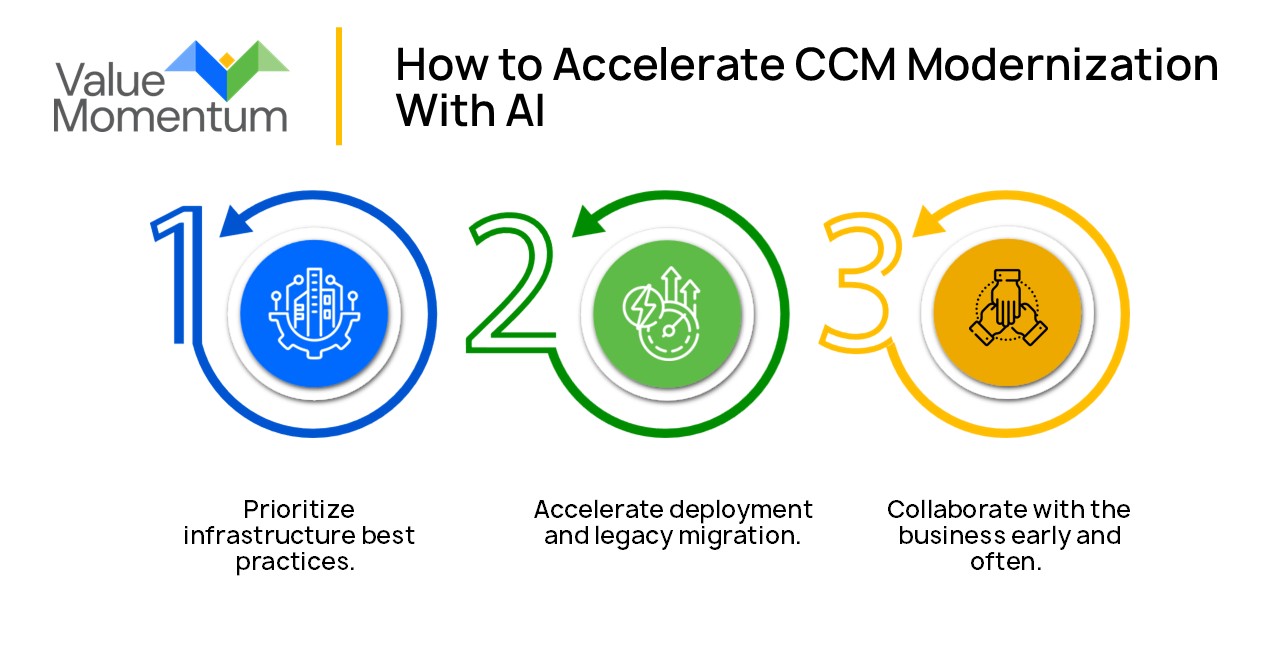
1. Prioritize infrastructure best practices.
No migration effort can succeed without a stable foundation in place. There must be API gateway access between third-party applications and an insurer’s CCM tool with always-on performance monitoring, logging, and backup processes in place. Modular, API-friendly cloud templates can help insurers enable dynamic and reusable components for multi-channel delivery across print, email, and digital communications.
Data is also a critical component of this strong foundation. Clean, scalable data models can help insurers minimize template-level logic, and centralizing rules from legacy structures into scripts and libraries ensures that vital data is accessible from a single source of truth, not siloed.
2. Accelerate deployment and legacy migration
Once a modern CCM platform has been selected and a carrier has made certain that it is compatible with the rest of the organization’s enterprise tech stack, transformation tools like ETL pipelines, API proxies, and schema repositories can be integrated to streamline the implementation.
Integration is not the endpoint, however. Insurers can leverage AI and automation to rationalize forms, removing unused or duplicate templates; to convert legacy code to the updated format needed by the new CCM system; and to bulk import forms of all complexities. Leveraging shared content, layouts, and sections can drastically accelerate development timelines.
3. Collaborate with the business early and often.
Forms should be prioritized with the business based on volume, frequency, and business criticality, and these business partners should be involved in the review and approval of designs, layouts, and logic of migrated forms. Using a wave-based migration approach that begins with simple, high-use forms enables parallel runs and rollback options for risk mitigation while helping the business get the forms it uses most often moved over quickly.
This also ensures that effective governance is built into automation and processes from the outset, with business user validation and decision-making factored in. Automating data transformation, output comparison, and regression tests and using modular design with strong version control ensure that technical efforts are not compromising any critical business outputs.
Staying competitive in the digital era requires insurers to optimize customer journeys, evolve with growing data availability, and adapt to customer input across channels. Working with systems integrators that offer AI accelerators and frameworks can help overcome challenges with CCM legacy migration, reducing the manual effort and timelines required to bring insurance CCM systems up to date.
The Next Step Toward CCM Legacy Modernization
Successful carriers are harnessing modern CCM technologies and integrating them with cloud-native core systems, new and traditional data sources, and AI and analytics capabilities to drive greater operational efficiency and the seamless digital experiences that modern customers have come to expect.
Every legacy modernization project is different, but when done properly, these efforts enhance the quality, relevance, and personalization of customer interactions, fostering trust and long-term loyalty. To learn more about how insurers are driving business success by prioritizing a modern CCM, read the case study “Multi-line Insurer Improves Customer Experience With SmartCOMM.”