

Insurance leaders track technical debt closely. Budgets account for it, modernization roadmaps are built around it, and HFS Research now estimates the industry’s accumulated technical and process debt at $200 billion. What rarely gets tracked with the same discipline is a different kind of debt: the widening gap between what a system does and if an organization understands why it does it.
I call this knowledge debt. It accumulates the same way technical debt does — one workaround, one undocumented decision, and one departed employee at a time. Except that knowledge debt never shows up on a balance sheet, and a re-architecture project can’t pay it down on its own. A carrier can replace its entire policy administration platform and still carry the same knowledge debt it started with if nobody captured the business rules and context the legacy system quietly held for years.
Technical debt gets the attention. But knowledge debt is just as disruptive, and it’s often the reason technical debt is so hard to resolve in the first place.
Why Knowledge Debt Goes Unnoticed
Knowledge debt doesn’t announce itself. A newly built system is usually well understood, since the team that built it still remembers every design decision, business rule, and reason a particular workaround exists, and the documentation, if it exists at all, still matches what the system actually does.
Then time passes, and the understanding starts to thin. New features get layered on top of old ones. Regulations shift, and the person who understood a particular integration takes a job somewhere else. A workaround introduced for a single exception quietly becomes a permanent fixture nobody thinks to question. Through all of this, nothing necessarily breaks. Policies still get issued, claims still get processed, and from the outside, the system looks exactly as healthy as it did before.
What erodes isn’t whether the system works. It’s the organization’s ability to explain why it works the way it does, and that distinction only becomes visible once someone tries to change it. This kind of accumulated, undocumented complexity is one of the most common reasons legacy migrations stall, since the real obstacle usually isn’t the new platform. It’s reconstructing a decade or more of decisions nobody wrote down the first time.
Critical Symptoms of Knowledge Debt
While legacy systems may keep functioning, an organization’s understanding of those systems does not. Because the decline is gradual rather than sudden, it rarely triggers the kind of alarm a missed deadline or a budget overrun does, at least, not until a major change forces the organization to confront how much information has actually slipped away.
This kind of debt doesn’t stay contained. It surfaces across the organization in five distinct, familiar forms.
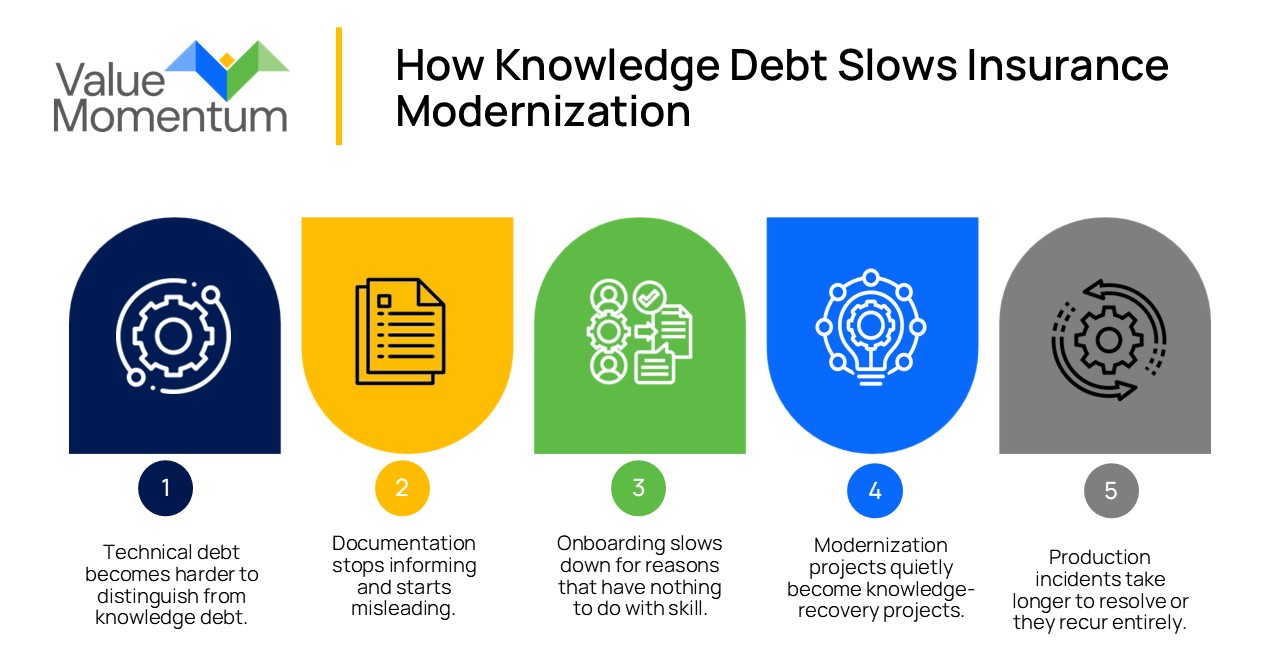
- Technical debt becomes harder to distinguish from knowledge debt. A system that’s difficult to change is often that way because no one fully understands it anymore, not because the underlying code is inherently flawed. This is one of the more specific hidden costs LegacyLeap identifies in aging systems: critical business logic locked in the heads of one or two people approaching retirement, with no documentation to recover it once they’re gone. In practice, this means a component that could be replaced in weeks if its logic were well understood instead takes months. That time frame is not because the replacement itself is hard, but because no one is confident enough in what the current system actually does to sign off on removing it.
- Documentation stops informing and starts misleading. Outdated documentation doesn’t just fail to help; it actively points teams toward assumptions that no longer hold, adding rework rather than preventing it. A requirements document written five years ago may describe a process that has since been patched, rerouted, or overridden by a dozen small exceptions, none of which ever made it back into the document itself. A team that trusts it at face value not only wastes time, but also builds on an incorrect foundation.
- Onboarding slows down for reasons that have nothing to do with skill. New hires aren’t struggling to learn the technology. They’re struggling to find context that was never written down anywhere they could access it. A capable engineer can read a codebase in days, but understanding why a particular exception exists, or which stakeholder to ask when something looks wrong, often depends entirely on tracking down the one or two people who happen to remember, if they’re still with the organization at all.
- Modernization projects quietly become knowledge-recovery projects. Long before a new platform gets built, teams often spend months reconstructing what the current one does and why. This phase rarely shows up on the original project timeline but frequently determines whether the rest of the initiative stays on schedule. What was scoped as a nine-month build can lose its first quarter entirely to interviews, document reviews, and code archaeology before a single line of the new system gets written.
- Production incidents take longer to resolve, or they recur entirely. When the root cause traces back to disconnected information rather than a new defect, the same failure can resurface months later because nothing was actually learned the first time. A support team may resolve an incident without ever connecting it to the undocumented business rule that caused it, which means the underlying gap is still there, waiting for the next person to rediscover it the hard way.
None of these five outcomes requires a new defect or a failed deployment to surface. They’re simply what happens when understanding is allowed to quietly disappear, one undocumented decision at a time.
Paying Down What You Can’t See
Knowledge debt rarely shows up on a project plan, a budget line, or a board slide, but its costs are real: slower onboarding, misleading documentation, ballooning modernization timelines, and unresolved incidents. Insurers who manage it well treat consolidating and connecting foundational knowledge as a deliverable in its own right, worth planning for before the technology decisions get made.
Erie Insurance took that approach when it set out to unify years of fragmented policy, billing, and claims data spread across legacy and modern systems, much of it governed by business rules that existed only in institutional memory. Read the full case study, “Erie Insurance Optimizes Data Operations With MarkLogic Enterprise Data Hub on AWS,” to see how a connected data foundation replaced years of scattered knowledge with a single, reliable view of the business.