



When commercial lines carriers evaluate their product content operations, forms management rarely receives the same attention as rate changes or underwriting rule updates. Rates change frequently, and they directly impact premiums. Rules govern eligibility and risk selection. Forms, on the other hand, are often treated as static. They get updated reactively, managed in isolation, and staffed as an afterthought. But thinking of them this way comes at a cost.
Policy forms define the actual terms of coverage: what is included, what is excluded, and what language governs a claim. When forms fall out of step with bureau updates, carriers risk falling out of compliance. If forms are not updated alongside changes to rates and rules, coverage gaps and pricing misalignments follow.
And when carriers lack the operational infrastructure to author, compare, and deploy forms efficiently, new product launches and state expansions get delayed, adding months to timelines that commercial lines carriers can rarely afford. High-performing carriers treat forms management not as a maintenance burden but as a discipline that has direct implications for speed to market, regulatory standing, and a successful product strategy.
5 Forms Management Practices That Accelerate Commercial Lines Growth
Forms management in commercial lines encompasses more than updating policy language when bureau circulars arrive. It involves identifying what has changed and understanding the downstream impact on coverages and endorsements. From there, it requires authoring carrier-specific content, coordinating development and quality assurance (QA) within the product release cycle, and maintaining governance over deviations that accumulate over time.
Here are the five key steps to building a disciplined forms management function.
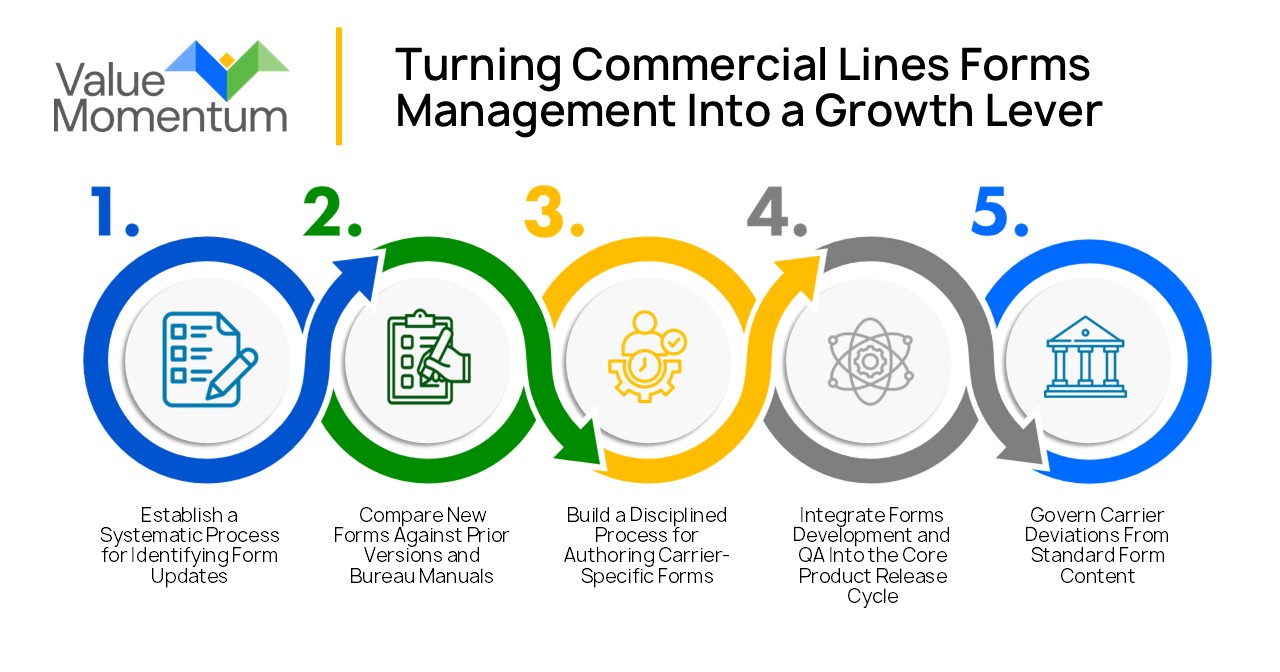
1. Establish a Systematic Process for Identifying Form Updates
Bureau circulars arrive on rolling schedules across multiple lines of business and all 50 states. Forms updates embedded within those circulars are particularly easy to defer. For example, rate changes have an immediate impact on premiums, while changes to form language may not surface as a problem until a claim is disputed or a regulatory examination uncovers a gap.
Carriers that manage forms effectively treat update identification as a structured, ongoing activity. That means establishing a consistent cadence for reviewing incoming circulars; assessing which changes are mandatory versus optional; and determining applicability by state, line, and coverage.
A midsize regional carrier ValueMomentum worked with found that implementing this kind of structured review across property, general liability, inland marine, and crime lines revealed a significant backlog of deferred form updates — exposure that had accumulated within the existing application management structure without visibility.
2. Compare New Forms Against Prior Versions and Bureau Manuals
Identifying that a form update exists is only the first step. Understanding what specifically changed requires a disciplined comparison process. Bureau form revisions can range from minor language clarifications to substantive changes in coverage scope or exclusion language. Carriers that skip or compress this step often discover the consequences during regulatory review or in coverage disputes.
Effective forms comparison works across two dimensions: 1. comparing the new bureau version against prior versions to isolate what changed and 2. comparing the updated form against the carrier’s current product configuration to identify where existing language diverges from the new bureau standard.
For one regional carrier executing a greenfield commercial lines implementation, rigorous form comparison across five lines of business was essential to building an accurate product documentation baseline and preventing inconsistencies from being carried forward into the new system.
3. Build a Disciplined Process for Authoring Carrier-Specific Forms
Not all commercial lines forms derive from bureau standards. Carriers regularly author proprietary forms to reflect their own risk appetite — adding endorsements; modifying attachment logic; creating segment-specific package offerings; or incorporating coverages that bureau content does not address, such as cyber, equipment breakdown, or professional liability.
The authoring process requires clear governance: defined criteria for when a proprietary form is warranted, documented applicability rules by line and coverage, and version control that keeps carrier-specific content aligned with the underlying bureau form as updates arrive.
Carrier-specific forms authored without that governance accumulate over time, drift from their original intent, and become difficult to reconcile when the next bureau update arrives.
4. Integrate Forms Development and QA Into the Core Product Release Cycle
Forms do not exist in isolation from rates and rules. When form changes are developed and tested separately from the rest of the product release cycle, carriers introduce timing mismatches that delay deployments, create coverage gaps, and increase defect rates during renewals and endorsements.
High-performing carriers coordinate forms development, including authoring, configuration on customer communication management platforms, and QA, within the same release cadence as rate and rule changes.
Forms that clear QA in isolation but have not been validated against current rates and rules are not release-ready. Integration is not a process improvement; it is a quality requirement.
5. Govern Carrier Deviations From Standard Form Content
Most carriers deviate from standard bureau forms to some degree. Those deviations, such as removing content not offered and managing eligibility through underwriting rules, are legitimate expressions of a carrier’s risk appetite and market strategy. The problem is not deviation itself; it is deviation without governance.
Business-driven form changes implemented without documented rationale accumulate over time, increasing upgrade complexity and creating traceability gaps that surface during regulatory reviews. A regional carrier managing a multi-state commercial lines expansion found that establishing a structured deviation framework across commercial auto, businessowners, workers’ compensation, property, and general liability was critical to maintaining upgrade integrity as the product footprint grew.
Carriers that document why a deviation was made, under what conditions, and how it should be revisited are far better positioned to manage future bureau updates without compounding the technical debt that ungoverned customization creates.
Individually, each of these practices reduces risk and improves execution. Collectively, they reframe forms management from a compliance burden into a capability that supports faster product launches, cleaner upgrades, and a more defensible product portfolio.
Building a Forms Management Practice That Scales
Forms management rarely appears on a carrier’s list of strategic priorities, but its absence has consequences that compound over time.
Deferred updates create compliance exposure. Ungoverned deviations increase upgrade complexity. And forms developed outside the product release cycle introduce defects that surface at the worst possible moments. Each of these outcomes slows the carrier down precisely when the market demands speed.
Treating forms management as a discipline rather than a task positions insurers to more effectively launch new products, expand into new states, and respond to market shifts without the drag of accumulated technical and compliance debt.
To learn more about how insurers are driving growth with improved approaches to forms and customer communication management, check out our case study “Fortune 500 Insurer Improves Efficiency and Experience With Claims Correspondence Modernization.”