



Assigning the right adjuster to the right claim may seem straightforward — yet in practice, many insurers get it wrong. When an initial assignment misses the mark, it can lead to delays, reassignments, higher handling costs, and frustrated policyholders. In one study, two-thirds of dissatisfied claimants cited slow settlement as the primary reason for their frustration, with 30% switching or considering switching carriers because of it.
Claims assignments set the tone for how quickly a claim is resolved, how fairly it’s handled, and how satisfied the policyholder feels throughout the process. But today’s rule-based systems can’t keep up with customers’ needs. They overlook important factors such as adjuster specialization and past claim outcomes, as well as the shifting nature of claims themselves.
To close this gap, insurers are beginning to adopt graph-based artificial intelligence (AI), an approach that combines intelligence with transparency and scalability to make smarter, more reliable claim-to-adjuster assignments.
Why Smarter Claims Assignment Matters
For insurers, the effectiveness of claims assignment is often underestimated. A poor match doesn’t just inconvenience adjusters; it also creates a cascade of problems, including longer settlement timelines, increased reassignments, inflated handling costs, and dissatisfied policyholders.
Traditional rule-based systems rarely capture the nuanced context of claims, leading to less accurate assignments. Worse still, they leave leaders with little transparency into why assignments were made, making accountability and continuous improvement difficult. Without smarter, data-driven approaches to assignment, insurers will continue to struggle with inefficiencies that drive up costs and yield a bad customer experience.
The urgency to improve assignment is amplified by growing pressure on claims organizations. Deloitte reports that insurers with higher turnover among experienced adjusters saw operational costs rise by about 12%, while carriers forced to rely on under-prepared talent reported up to 20% higher indemnity payouts. At the same time, claim severity and complexity continue to rise across the P&C market, further stretching adjuster capacity.
By embedding intelligent solutions at the very start of the claims management journey, carriers can reduce leakage caused by inefficiency, improve combined ratios, reduce the need for reassignments, and save adjusters hours of time. Balancing workloads and cutting down on inefficiencies also helps build operational resilience and scalability — critical advantages in a market defined by constant change.
The Solution: Graph-Based AI for Smarter Claims Assignment
Leveraging emerging technology and analytics capabilities like graph-based AI can help insurers take their claims assignment to new levels of success. For instance, a major carrier leveraged AI to revamp its entire claims journey and saw major improvements. The organization cut its average time to assess liability for complex cases by 23 days and improved routing accuracy by 30%.
Graph-based AI merges generative AI (GenAI) and graph-based computation to help models assess relationships between seemingly disparate concepts and data points. Unlike traditional methods used in claims assignment, graph-based AI can analyze the relationships between claim attributes, adjuster histories, and past outcomes.
Identifying this level of information up front enables carriers to match each claim to the most suitable adjuster from the outset, improving the efficiency, cost-effectiveness, and scalability of the entire claims process.
Not every data resource is well versed with graph-based AI and its application to insurance, however. Here are five critical components of an effective graph-based AI framework to get organizations started with smarter claims assignment:
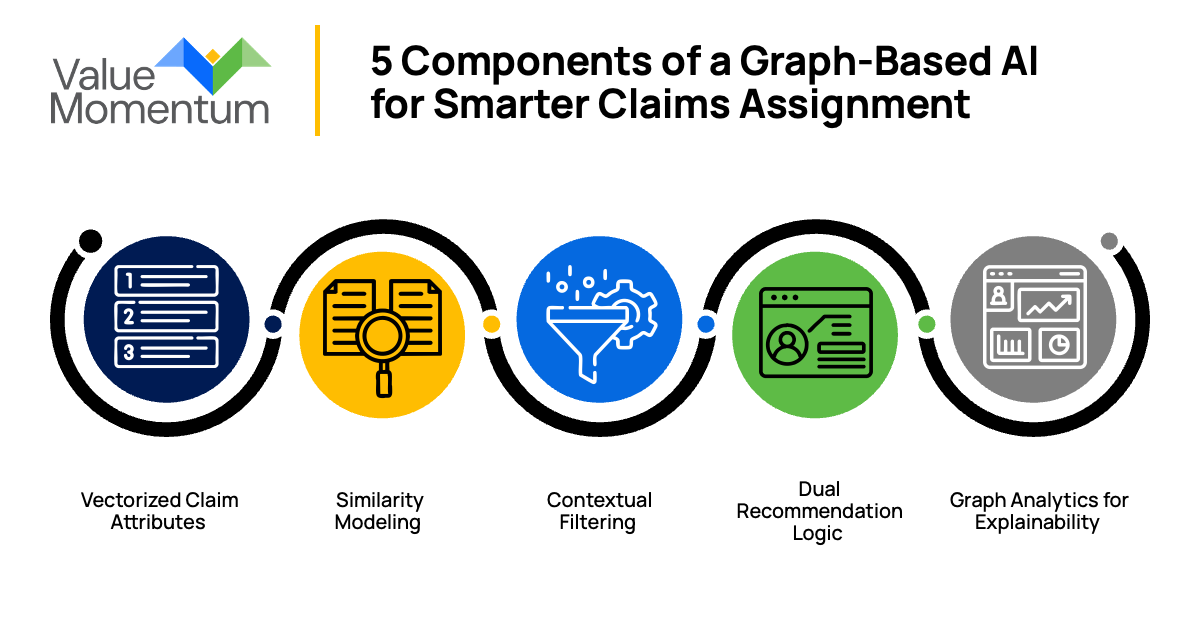
1. Vectorized Claim Attributes
Every new claim is broken down into structured data points, including geography, cause of loss, injury type, urgency, and litigation flags. These attributes are then vectorized, which means converting them into machine-readable formats that advanced models can use to compare them with thousands of past cases. This structured foundation enables the system to detect subtle similarities across claims that traditional rules would miss.
2. Similarity Modeling
Once vectorized, claims are analyzed using cosine similarity to identify historical cases most comparable to the new one. By looking at how those past claims were resolved — including cycle times, litigation rates, and settlement fairness — the system can recommend adjusters with a proven track record in similar scenarios. This shifts assignment from guesswork to evidence-backed matching.
3. Contextual Filtering
Recommendations are then refined with contextual filters. These ensure that only adjusters with the right line-of-business experience, regulatory credentials, and specialization are considered. Performance metrics such as closure rates, quality scores, and customer satisfaction (e.g., NPS) can also be integrated, ensuring the “best fit” is not only technically qualified, but also consistently delivers strong outcomes.
4. Dual Recommendation Logic
The framework surfaces both experienced adjusters with proven results and newer adjusters whose profiles align with the claim’s needs. This balance ensures workloads are distributed evenly and builds bench strength without sacrificing outcomes.
5. Graph Analytics for Explainability
Behind every recommendation is a network of relationships connecting claims, adjusters, and results. Graph-based analytics tools like Neo4j visually map these connections, allowing leaders to see why a claim was assigned to a particular adjuster. Interactive dashboards make the decision-making process transparent and auditable, which builds confidence with managers, regulators, and even adjusters themselves.
By moving beyond static rules to relationship-driven intelligence, graph-based AI transforms claims assignment from a hidden bottleneck into a strategic enabler, with positive outcomes across operations, finance, and customer satisfaction.
The Right Adjuster, Every Time
Rule-based systems may have worked in the past, but with rising complexity, adjuster shortages, and higher customer expectations, archaic solutions will no longer cut it. Graph-based AI offers insurers a way to bring intelligence, transparency, and scalability into assignment.
Carriers that embrace this shift can lower costs, improve cycle times, and deliver a smoother policyholder experience from day one. The payoff is more than operational efficiency — it’s a stronger competitive position in a market where customer experience is the ultimate benchmark.
Want to see how AI is reshaping every stage of the claims process? Watch our webinar, “AI Insider Insights: AI Claims Use Cases