


Social inflation has rapidly become one of the most disruptive forces in property and casualty (P&C) insurance, escalating litigation rates and settlement values. In the years following the COVID-19 pandemic, court backlogs and shifting juror attitudes, along with heightened public distrust in institutions, have all magnified the upward pressure on liability costs.
At the same time, advanced plaintiff strategies — including leveraging third-party litigation funding (TPLF), increasingly sophisticated legal advertising, and AI-enabled case modeling — are reshaping the dynamics of negotiation and trial outcomes. Nuclear verdicts (awards exceeding $10 million) have surged as a result, with the median value reaching $44 million in 2023, more than double 2021 levels. Recent analyses also show that inflation-adjusted personal injury and wrongful death awards have grown at a 7.6% compound annual rate over the past decade, underscoring the structural nature of this shift.
For insurers, this escalation is no longer a short-term anomaly; it’s a fundamental change in liability exposure. Understanding what’s driving social inflation and where it poses the greatest risk is now essential for protecting reserves, adapting claims strategies, and sustaining profitability in an increasingly volatile litigation environment.
How Has Social Inflation in Insurance Intensified?
What began as a gradual shift in juror attitudes and legal behavior in the mid-2010s has accelerated into a more complex and volatile environment shaped by economic pressure, social dynamics, and evolving litigation strategies. As already mentioned, these forces only intensified after COVID-19, when court delays, changing public sentiment, and new trial formats increased both the frequency and severity of large-loss outcomes.
Several drivers now work together to raise claim costs. The erosion of tort reform protections has opened the door to broader interpretations of liability, while TPLF has enabled more cases to proceed, and even stay active, for longer. At the same time, plaintiffs’ attorneys have adopted more sophisticated approaches, including psychological tactics like the reptile theory and highly targeted legal advertising. Social media’s influence on public opinion, combined with growing distrust of corporations, has further shifted how juries evaluate damages.
Technology is adding new momentum to this trend. Post-pandemic virtual proceedings introduced more informal courtroom dynamics, and emerging AI-enabled tools are helping plaintiff teams refine case valuations, venue strategies, and argument design more quickly. As a result, verdicts and settlements are rising faster than traditional inflation can explain — and plaintiff win rates have increased from roughly 53% to 64% between 2010 and 2019, underscoring how the litigation environment has fundamentally shifted.
These forces are all reshaping liability exposure across the P&C landscape, and their impact is felt most acutely in several high-risk lines of business, which are now driving new pressures across claims, underwriting, and enterprise risk management.
What Social Inflation Means for P&C Insurers: Operational Pressures and Rising Exposure
These impacts are most acute in lines with long-tail, complex, or highly subjective claims, including commercial auto, medical malpractice, directors and officers (D&O), excess liability, general liability, and workers’ compensation. Carriers are seeing steeper severity curves, broader interpretations of liability, and more willingness among plaintiffs to pursue litigation rather than settle early.
As these trends converge, insurers face mounting pressures across claims, reserving, underwriting, and enterprise risk. Below are the most significant ways social inflation is reshaping carriers’ operations today.
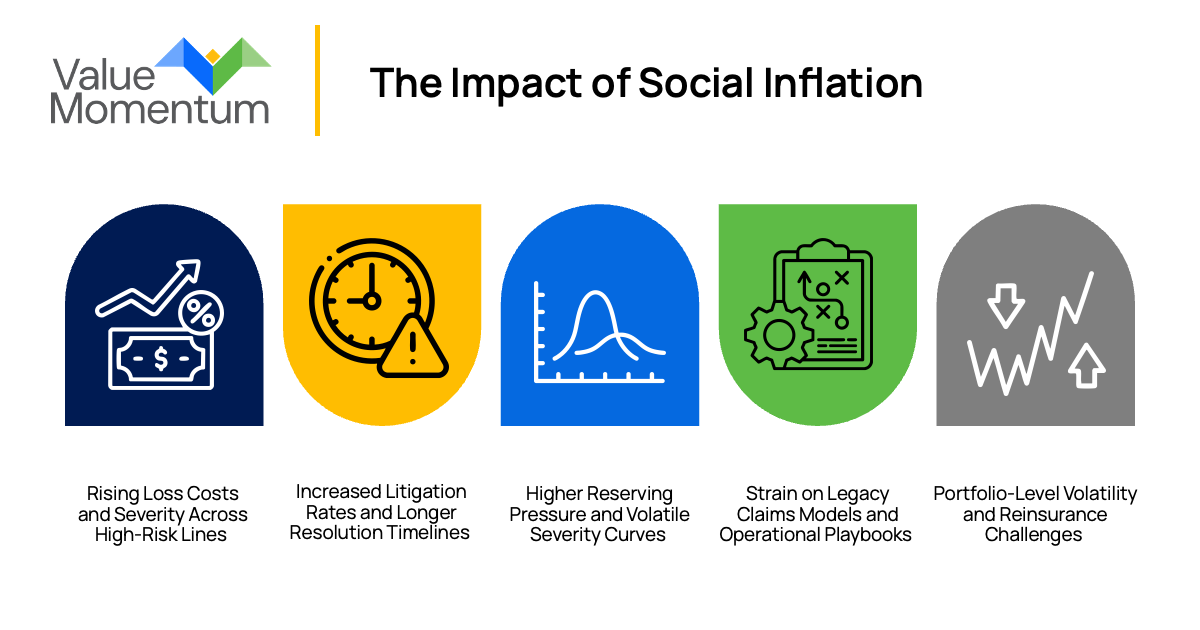
1. Rising Loss Costs and Severity Across High-Risk Lines
Loss severity continues to climb at a pace that far outstrips traditional economic inflation. Expanded interpretations of bodily injury, higher awards for non-economic damages, and more assertive plaintiff demands are driving up costs across long-tail lines.
One clear example comes from commercial auto: Nuclear verdicts in trucking cases now routinely exceed $25 million, with some judgments reaching into the hundreds of millions. This escalation increases pressure on claims budgets, contributes to volatile loss ratios, and expands the likelihood that mid-severity claims will escalate into high-exposure events.
2. Increased Litigation Rates and Longer Resolution Timelines
More claims are entering litigation, and once they do, they are taking longer to resolve. The growth of TPLF and rising plaintiff confidence has extended litigation timelines, while post-pandemic court backlogs continue to influence case progression.
As cases remain open for longer periods, defense costs accumulate, the discovery process becomes more complex, and the window for escalation widens. Longer timelines also introduce greater uncertainty around evidence preservation and witness availability, which can shift negotiation leverage toward plaintiffs. For insurers, this means that even routine claims are likely to escalate into high-severity events without early intervention.
3. Higher Reserving Pressure and Volatile Severity Curves
Traditional reserving models are under strain as historical loss patterns no longer predict future outcomes with the same accuracy. With severity rising and verdicts becoming more volatile, actuaries face greater pressure to account for larger tail risks and broader outcome ranges.
This challenge is reinforced by macro-level trends: in 2020, the U.S. tort system’s total cost reached approximately $443 billion, or about 2.1% of GDP — a figure that grew faster than both inflation and economic output. As a result, insurers must revisit trend assumptions, strengthen reserve governance, and improve coordination between claims and actuarial teams to maintain reserve adequacy.
4. Strain on Legacy Claims Models and Operational Playbooks
Many claims organizations still rely on playbooks, KPIs, and workflows built for a very different litigation environment. Today’s conditions, such as more coordinated plaintiff strategies, access to litigation funding, and greater emotional influence in jury decisions, require updated approaches to case investigation, negotiation, and escalation.
In practice, plaintiffs often begin shaping their narratives long before an insurer even opens the file. Medical experts, economic loss models, and psychological arguments are sometimes assembled in advance, giving plaintiffs a strategic advantage early in the claim’s life cycle. Traditional KPIs such as cycle time or early settlement ratios do not fully capture the risks associated with these dynamics. Claims teams need more nuanced triage models and clearer guidance on identifying early signals of escalation to respond effectively.
5. Portfolio-Level Volatility and Reinsurance Challenges
As large loss outcomes become more frequent, insurers face growing volatility across entire portfolios. This affects pricing, retention levels, and reinsurance negotiations. Reinsurers are responding to social inflation trends by tightening terms and adjusting pricing, making it more critical for carriers to demonstrate disciplined risk selection and claims management.
Industry reporting highlights why reinsurers are cautious: Direct combined ratios reached 109% in commercial auto and 106% in medical malpractice between 2019 and 2023, which is a sustained indication of severity-driven strain on profitability. Carriers with stronger early-warning systems, better insights into emerging litigation patterns, and proactive legal strategies will be better positioned to manage reinsurance costs and protect margins.
To navigate this environment successfully, insurers will need more advanced claims capabilities and stronger litigation analytics as well as closer alignment across claims, actuarial, and underwriting functions.
Preparing for a More Volatile Liability Environment
Social inflation is reshaping liability exposure, but it doesn’t have to reshape an insurer’s performance. With sharper insights, more adaptive claims models, and a renewed focus on litigation readiness, carriers can respond with confidence — and even turn today’s challenges into operational advantages.
Insurers that take action now won’t simply keep pace with the market. They’ll define what strong, modern claims organizations look like in a world where severity and complexity are rising.
To learn more about how social inflation impacts the insurance industry and how to prepare for it, read our whitepaper, “Combating Social Inflation: Strategies for Claims Organizations to Reduce Leakage.”